Governance & Trust
AI Systems Built with Governance, Not Afterthoughts
ZigmaNeural designs and delivers AI & IT systems with security, compliance, and responsible use embedded from day one.
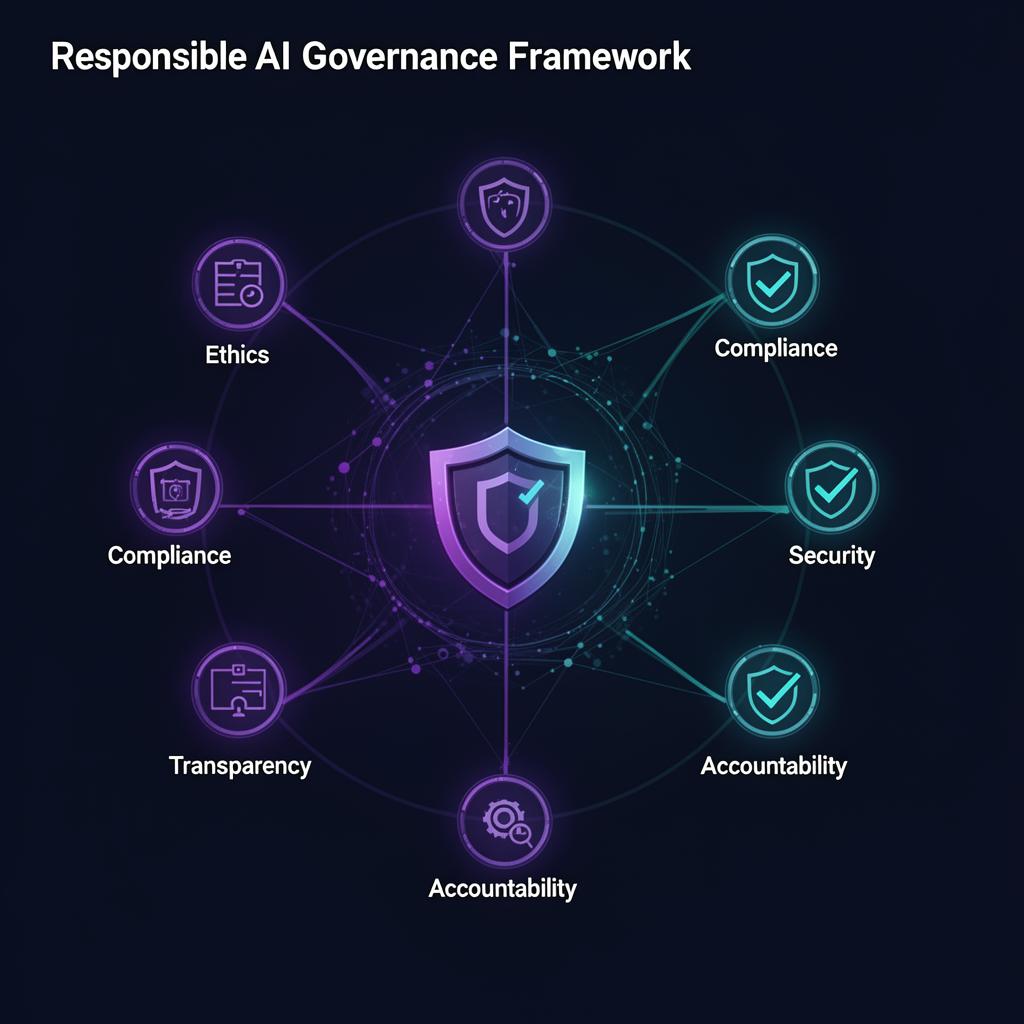
What is enterprise AI governance?
Enterprise AI governance is the set of policies, controls, and evidence that keep AI systems accountable in production. It covers model and data approval, human oversight, evaluation and drift monitoring, access control, incident handling, and audit trails — aligned to the EU AI Act, GDPR, DPDP, and PDPL requirements that apply to your markets.
Our Governance Principles
Every system we design follows these principles — not as a checklist, but as architectural decisions.
Responsible AI by Design
- Human oversight in critical decisions
- Bias awareness and mitigation
- Explainability as a core requirement
Data Privacy & Security
- Data minimization principles
- Secure storage & access controls
- Compliance-aware architecture
Risk-Aware Architecture
- Failure mode analysis
- Controlled deployments
- Audit-friendly system designs
Continuous Oversight
- Monitoring & logging
- Model performance checks
- Ongoing risk evaluation
Governance at Every Stage
Governance isn't a phase — it's embedded across the entire project lifecycle.
Decision Phase
AI suitability & risk assessment
Design Phase
Secure architecture & compliance-aware planning
Build Phase
Controlled development & data protection enforcement
Operate Phase
Monitoring, governance controls & continuous improvement
Aligned with Industry Standards
We align our processes with recognized frameworks and best practices.
Common AI Risks We Help Prevent
Real risks we see in enterprise AI projects — and areas where governance makes a measurable difference.
Who Governance Is For
Good Fit
- Enterprise & mid-market businesses
- Regulated industries (Healthcare, BFSI)
- Risk-aware leadership teams
- Organizations scaling AI responsibly
Not a Fit
- Quick AI demos without governance intent
- Experiment-only projects
- Governance-optional mindsets
- Teams unwilling to invest in controls
From Governance to Execution
Strong governance enables safe and scalable AI adoption. We help businesses move from controlled decisions to real-world AI implementation.
Frequently Asked Questions
What is the Governance page for?
This page explains how ZigmaNeural embeds security, compliance, and responsible AI practices into every project from day one — reducing risk for enterprise buyers.
Who is AI governance for?
Enterprise and mid-market decision-makers, compliance officers, CTOs, and risk managers evaluating AI adoption with governance requirements.
When should I use AI governance services?
When you are planning AI adoption that involves sensitive data, regulatory requirements, or operational risk — governance should be part of the design phase, not an afterthought.
What happens after engaging governance services?
We conduct a risk and compliance assessment, design governance-aware architecture, and provide ongoing monitoring frameworks aligned with ISO and industry standards.
What is agentic AI governance?
Agentic AI governance is the set of controls that keep autonomous AI agents predictable: scoped tool permissions, human approval gates for high-impact actions, full action logging, evaluation before release, and kill-switch rollback. It extends model governance to cover what an agent is allowed to do, not just what it is allowed to say.
What governance controls are needed for agentic AI?
Six controls cover most enterprise risk: (1) least-privilege tool and data scopes per agent, (2) human-in-the-loop approval for financial, legal, or customer-facing actions, (3) immutable audit trails of every agent step, (4) pre-release evaluation suites with regression thresholds, (5) runtime guardrails for prompt injection and data exfiltration, and (6) an owner accountable for each agent in production.
How do enterprises manage agentic AI risk management in regulated industries?
Treat each agent as a controlled system: classify it by impact tier, map it to the applicable regime (EU AI Act, GDPR, UAE/KSA PDPL, India DPDP), document intended use and limitations, run bias and safety evaluations, and review incidents monthly. High-impact agents stay advisory until evidence supports autonomy.
Why is observability so important in governing agentic AI systems?
Agents chain many steps, so a single wrong tool call can cascade. Observability — traces of prompts, tool calls, retrieved context, costs, and outcomes — is the only way to explain a decision after the fact, detect drift, prove compliance to auditors, and cap runaway spend.
How do you secure agentic AI against prompt injection?
Separate untrusted content from instructions, allow-list the tools each agent can call, validate every tool input and output, never let retrieved text grant new permissions, sandbox code execution, and require signed approval for irreversible actions. Assume any content the agent reads may be hostile.
Next step
See how your controls score before the next AI build
The free AI Readiness Assessment includes a governance and security dimension, so you get a concrete list of gaps instead of a generic checklist.
Related reading