Why Every SaaS Business Needs an AI-First Infrastructure Strategy Introduction
The SaaS industry is entering a new phase. For years, success was driven by feature velocity, pricing models, and customer acquisition strategies. Today, intell
What this means for you
>
This article breaks down a technical topic in plain English so a business owner — not just an engineer — can decide what to do next. Look for short paragraphs, simple examples, and clear takeaways.
The SaaS industry is entering a new phase.
For years, success was driven by feature velocity, pricing models, and customer acquisition strategies. Today, intelligence has become the new competitive advantage.
Artificial Intelligence is no longer experimental. According to McKinsey’s State of AI report, more than half of organizations now use AI in at least one business function. Yet only a small percentage successfully scale it across operations.
The gap is not about access to AI tools. It is about infrastructure.
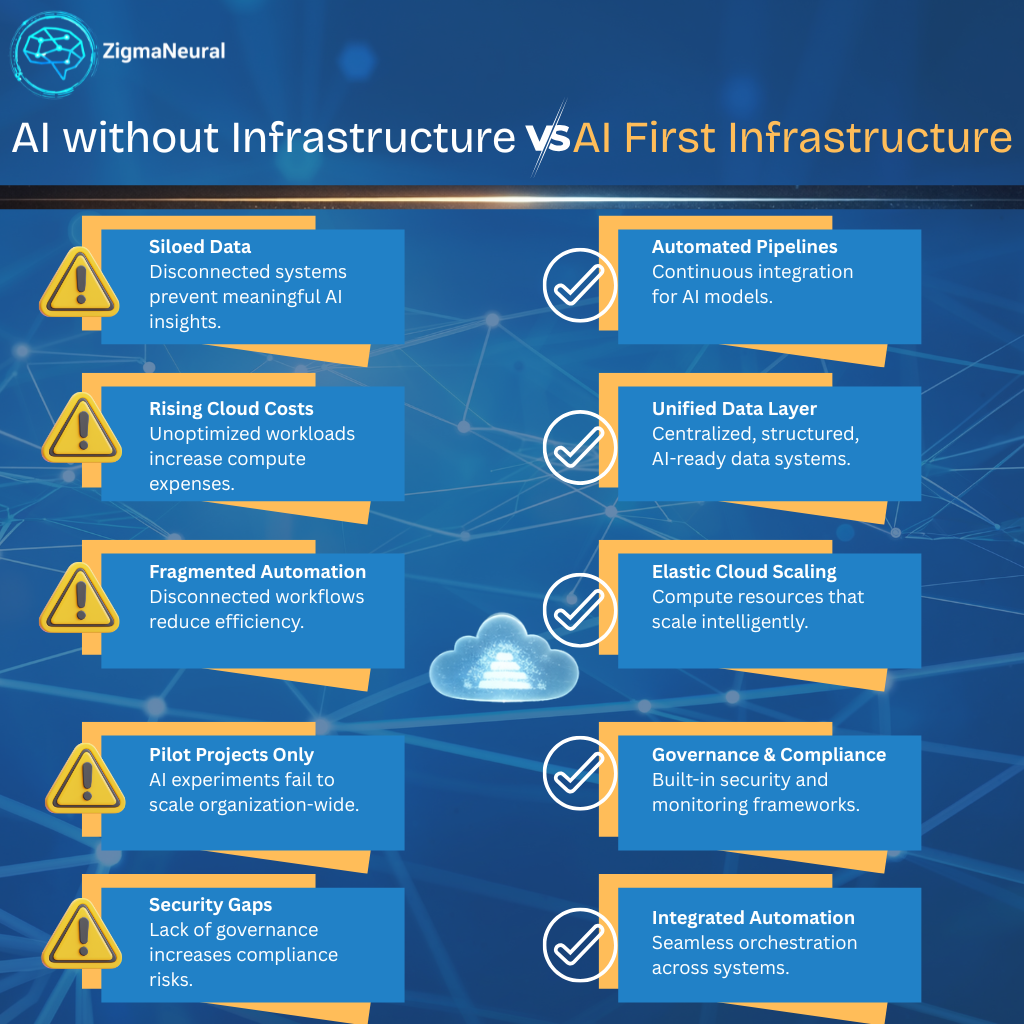
An AI-first infrastructure strategy ensures that your cloud, data systems, security frameworks, and automation layers are designed to support AI workloads from the ground up. Without it, AI becomes a patchwork experiment. With it, AI becomes an operating system.
For SaaS businesses aiming to scale globally, reduce costs, and drive intelligent growth, this shift is not optional.
It is structural.
What Is an AI-First Infrastructure Strategy?
An AI-first infrastructure strategy means designing your SaaS architecture so that AI is embedded at the foundational level — not layered on top.
It includes:
Cloud-native AI architecture Centralized data pipelines Automated DevOps environments
Real-time monitoring systems
Governance and compliance layers
Scalable compute resources
It transforms AI from a feature into a capability.
The Scaling Problem in Modern SaaS
Many SaaS companies integrate AI features: Chatbots
Recommendation engines
Predictive dashboards
Smart onboarding flows
But few redesign their backend systems to handle:
Real-time inference
High-volume data streaming
Multi-model orchestration
Continuous learning loops
BCG reports that only ~26% of organizations successfully scale AI to generate meaningful business value.
The difference lies in infrastructure maturity.
## Why AI-First Infrastructure Is Critical for SaaS
1. Intelligent Scalability
Traditional SaaS scaling focuses on user growth. AI scaling focuses on:
Compute elasticity
Model retraining pipelines
GPU resource allocation
Distributed data systems
Without AI-ready architecture, costs rise exponentially as workloads increase. Cloud-native AI infrastructure ensures:
Horizontal scalability
Containerized deployments
Cost-efficient orchestration
This protects margins while enabling innovation.
- Data as a Strategic Engine
AI depends on structured, accessible data.
Many SaaS platforms operate with fragmented systems:
CRM data in one silo
Product analytics elsewhere
Support data isolated
Billing data disconnected
An AI-first infrastructure strategy centralizes data pipelines and enables: Unified analytics
Real-time personalization
Churn prediction
Behavioral modeling
Data becomes fuel — not friction.
- Operational Automation at Scale
SaaS automation strategy must extend beyond marketing workflows. AI-first infrastructure automates:
Customer segmentation
Usage-triggered pricing models
Support ticket prioritization
DevOps anomaly detection
Security alerts
This reduces operational overhead while improving system resilience. It enables growth without proportional headcount increases.
- Cost Optimization in Cloud Environments
AI workloads are resource-intensive. Without proper orchestration:
GPU costs spike
Redundant data pipelines emerge
Idle resources drain margins Cloud-native AI architecture optimizes: Auto-scaling clusters
Intelligent workload distribution
Usage-based resource allocation
This transforms AI from a cost center into a profit driver.
- Governance and Risk Mitigation
AI introduces new exposure areas: Data privacy risks
Compliance failures
Model bias
Unauthorized system actions
An AI-first infrastructure strategy includes: Role-based access control
Audit logs
AI monitoring dashboards
Governance frameworks
Security cannot follow AI deployment. It must precede it.
Competitive Advantage in an AI-Driven SaaS Market
PwC estimates AI could contribute more than $15 trillion to the global economy by 2030. The SaaS companies that capture disproportionate value will not simply adopt AI.
They will orchestrate it.
AI-ready architecture enables:
Adaptive product experiences
Continuous feature optimization
Intelligent pricing experimentation
Real-time operational insights
Infrastructure determines whether AI enhances the product or destabilizes it.
Common Mistakes SaaS Companies Make
Many organizations: Treat AI as a plugin
Skip infrastructure audits Ignore data quality
Underestimate compute demands
Overlook governance requirements
The result?
Pilot success. Enterprise stagnation.
AI-first infrastructure strategy prevents this trap.
Key Components of AI Infrastructure for SaaS
### Cloud-Native AI Architecture
Scalable environments designed for AI model deployment.
H3: Centralized Data Lake or Warehouse
Unified storage to power machine learning pipelines.
API-First System Design
Seamless integration across SaaS services.
Observability Framework
Monitoring model performance and system health.
Automation-Oriented DevOps
Continuous integration for ML systems.
Transitioning to AI-Ready Architecture
SaaS leaders should begin with: Infrastructure audit
Data maturity assessment Cloud cost analysis
Automation opportunity mapping Governance review
This is not about rebuilding everything. It is about redesigning strategically.
How Zigma Supports AI-First SaaS Growth
At Zigma, we help SaaS companies design, build, and govern AI systems that operate securely and efficiently at scale.
Our focus includes:
AI automation strategy
Cloud engineering optimization SaaS infrastructure modernization Governance frameworks
Scalable AI deployment models The goal is not experimentation.
The goal is operational intelligence.
Conclusion
AI is reshaping SaaS at the structural level.
An AI-first infrastructure strategy is not about adding features. It is about redesigning systems to support intelligent automation at scale.
Without infrastructure alignment, AI creates complexity. With it, AI creates compounding advantage.
SaaS businesses that act now will lead. Those that delay will retrofit under pressure. The future of SaaS is not feature-driven.
It is intelligence-driven.
External links
[https://www.mckinsey.com/capabilities/quantumblack/our-insights/the-state-of-ai](url)
[https://www.bcg.com/publications/2023/ai-adoption-and-value-creation https://mitsloan.mit.edu/ideas-made-to-matter/how-organizations-succeed-scale-ai ](url)[https://www.pwc.com/gx/en/issues/analytics/assets/pwc-ai-analysis-sizing-the-prize-report.pdf ](url)[https://www.accenture.com/us-en/insights/artificial-intelligence https://cloud.google.com/architecture/ai-ml
https://aws.amazon.com/machine-learning/ ](url)[https://www.nist.gov/itl/ai-risk-management-framework https://oecd.ai/en/](url)
Stay ahead of enterprise AI
Get monthly briefings on AI architecture, governance, and platform engineering — written for CTOs and founders. No fluff.
ZigmaNeural
Written by the ZigmaNeural engineering and AI team. We help enterprises design, build, and govern AI systems for real-world outcomes.