OpenAI Commits to 8 GW of AI Infrastructure in Ohio: Why AI Is Becoming an Energy and Cloud Challenge
OpenAI has announced an agreement for approximately 8 gigawatts-IT at the PORTS-Pike Technology Campus in Ohio. The lesson for enterprises is not to copy the scale, but to size their own AI workloads honestly.
Why is AI becoming an energy and infrastructure challenge?
Because frontier AI capacity is now limited by power, transmission, cooling and construction rather than chip supply, as shown by OpenAI's agreement for roughly 8 gigawatts-IT in Ohio with SB Energy, NVIDIA and the U.S. Department of Energy.
Short Answer
OpenAI announced an agreement to secure approximately 8 gigawatts-IT at the PORTS-Pike Technology Campus in Pike County, Ohio, working with SB Energy, NVIDIA and the U.S. Department of Energy. OpenAI states it will pay project-specific energy and infrastructure costs and make long-term investments in the surrounding community.
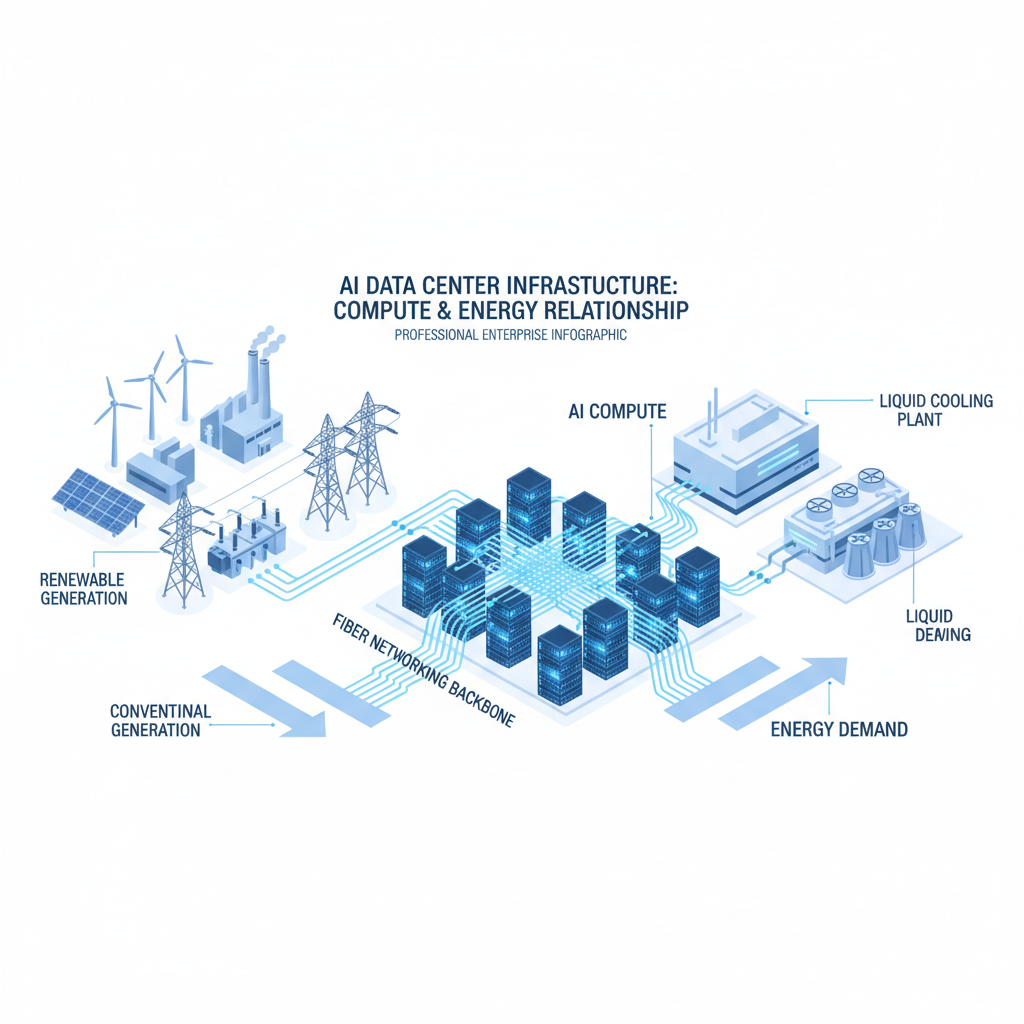
For context, 8 GW is a scale normally discussed in national grid planning, not IT procurement. It is a clear signal that frontier AI has become a physical infrastructure programme: land, power, transmission, cooling, fibre and construction schedules, not just chips.
For everyone who is not a frontier lab, the useful takeaway is the inverse of the headline. The discipline that matters is sizing your workload accurately, not securing capacity aggressively.
Why AI Needs So Much Physical Infrastructure
A large AI deployment consumes a long chain of resources, and each link has a lead time measured in months or years:
- Accelerators and compute
- High-bandwidth memory
- Storage for datasets, checkpoints and model artefacts
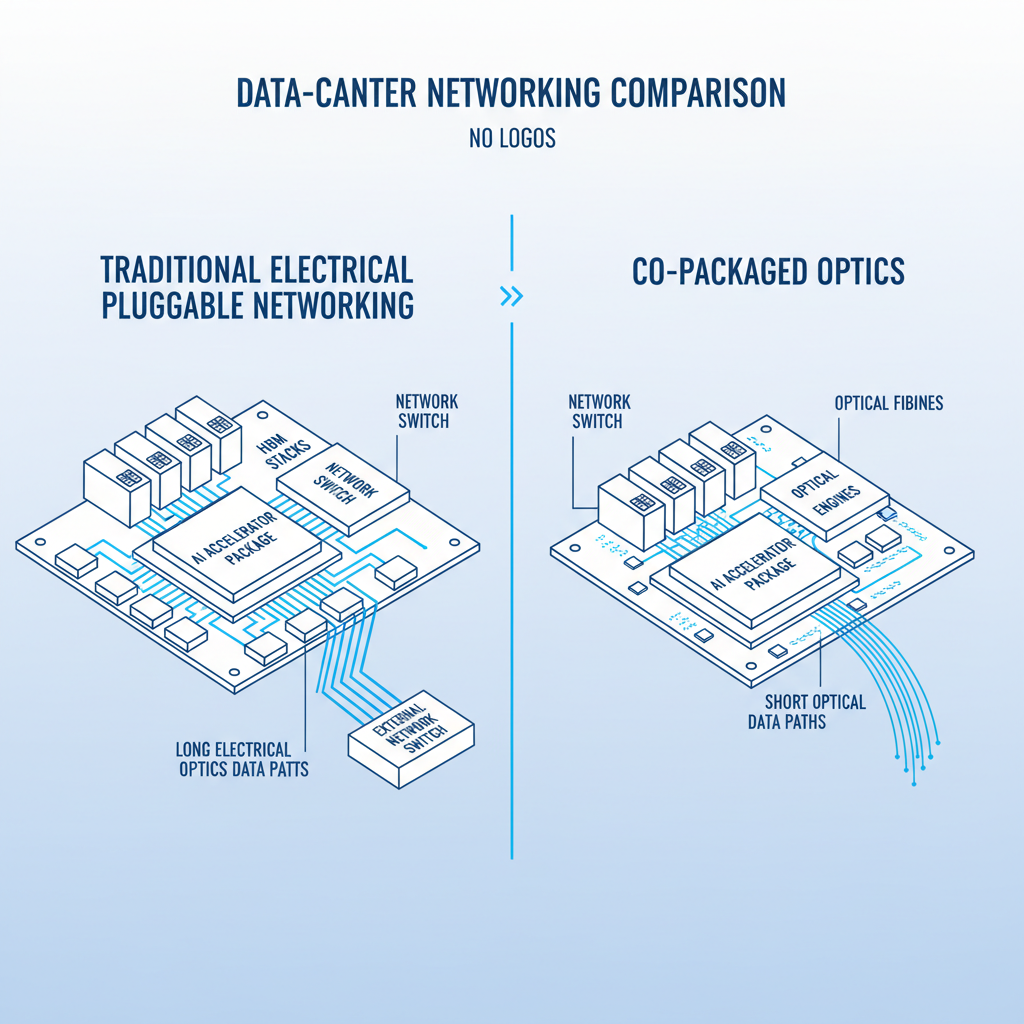
- High-speed networking and optics
- Cooling — increasingly liquid rather than air
- Electrical supply, substations and transmission capacity
- Data-centre buildings and land
- Fibre connectivity
- Physical security and operations staff
The constraint that has changed most is power. GPUs can be ordered. Grid interconnection cannot be ordered on the same timescale — which is why an agreement of this type involves an energy partner and a government department, not only a hardware vendor.
Compute Availability Has Become Strategy
For most of the software era, infrastructure was an implementation detail below the product. For large AI systems, it is upstream of the product. What you can build depends on what you can power and cool.
That reframes questions leadership teams now have to answer:
- How much compute can we actually access, and when?
- How quickly can capacity be added if a workload succeeds?
- Is sufficient electrical supply available at our chosen location?
- Can the facility cool the density modern accelerators require?
- Is network capacity adequate for training and serving?
- What is the total cost, not the hardware cost?
Frontier labs answer these with multi-gigawatt agreements. Enterprises answer them by choosing the right architecture — and usually by not owning infrastructure at all.
Cloud, Private, or Hybrid
Cloud. Fast to deploy, elastic, no facility to operate, and immediate access to specialised hardware and networking advances. The trade-offs are cost at sustained scale, accelerator availability during demand spikes, data transfer charges and a degree of vendor dependency.
Private infrastructure. More control, potentially better long-run economics at genuinely high utilisation, and full customisation for residency or latency requirements. The trade-offs are capital commitment, operations staffing, cooling engineering, hardware refresh cycles and physical security.
Hybrid. Where most enterprises land: steady-state inference in the most controlled and economical environment, elastic training and experimentation in cloud.
The variable that decides it is sustained utilisation. Below roughly 60–70% sustained utilisation, owning accelerators rarely beats renting them — and most organisations significantly overestimate their own utilisation before measuring it.
AI Cost Is Not GPU Cost
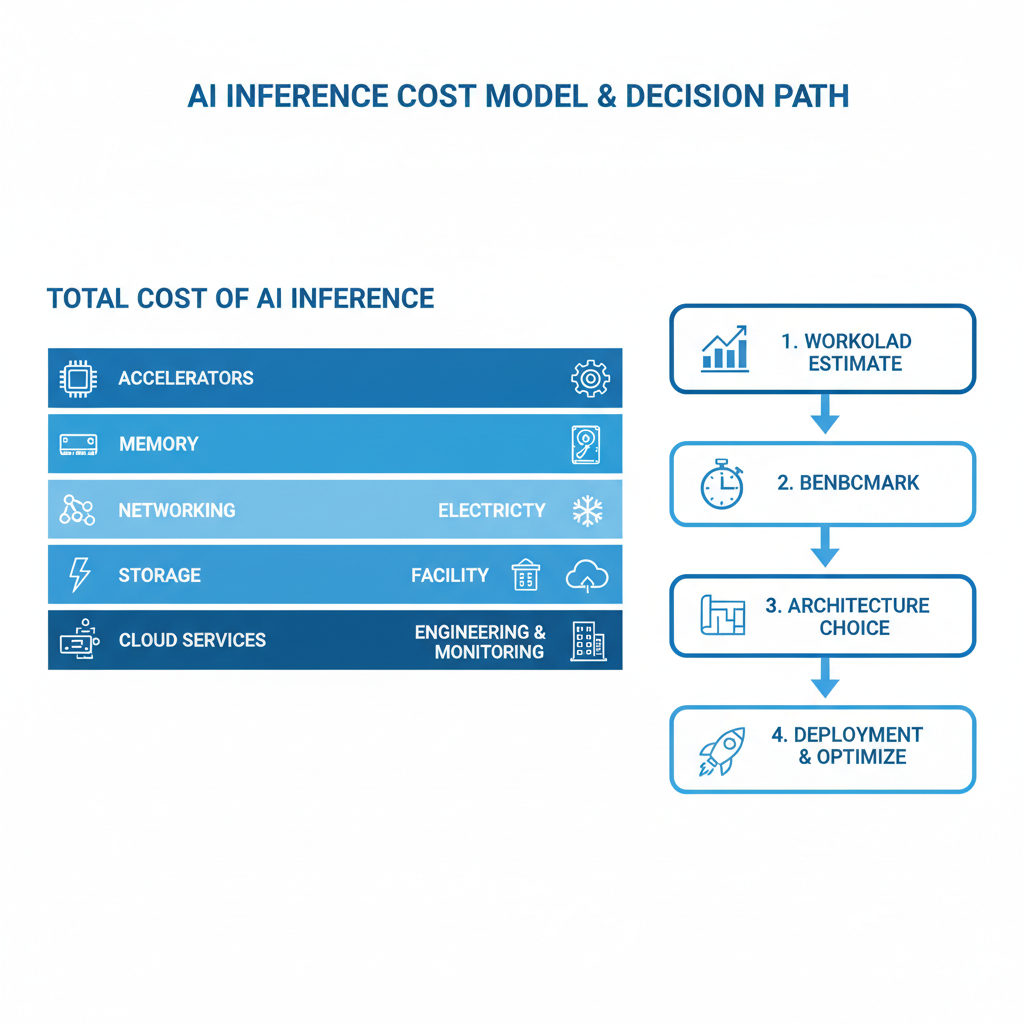
The most common modelling error is calculating GPU price multiplied by GPU count and calling it a budget. Real cost includes:
| Component | Cost consideration |
|---|---|
| Accelerators | Purchase or hourly rental |
| Memory | HBM and host system memory |
| Networking | High-speed interconnect and optics |
| Storage | Datasets, checkpoints, model artefacts, backup |
| Electricity | Continuous draw, including idle |
| Cooling | Thermal management, increasingly liquid |
| Facility | Space, racks, power distribution, redundancy |
| Cloud services | Managed inference, orchestration, egress |
| Engineering | Deployment, tuning, MLOps, on-call |
| Observability | Monitoring, evaluation, incident response |
| Idle waste | Reserved capacity that is not utilised |
Two of these dominate real invoices in ways teams do not predict: idle waste and egress. We regularly find reserved GPU capacity sitting at low utilisation, and data transfer charges that exceed the compute they support.
What Smaller Organisations Should Actually Do
No enterprise outside a handful of labs needs to think in gigawatts. The equivalent discipline at your scale is honest sizing.
Work through this before signing anything:
- Define the workload. Which specific task, with what quality bar?
- Estimate volume. How many users, requests per day, tokens per request, at what concurrency?
- Set the latency requirement. Interactive chat, batch enrichment and real-time detection have very different architectures and costs.
- Test a smaller model. A well-evaluated small or mid-size model frequently matches a frontier model on narrow enterprise tasks at a fraction of the cost.
- Compare three options on the same workload: managed API, cloud GPU instances, self-hosted inference.
- Benchmark honestly. Accuracy, p95 latency and cost per successful request — not tokens per second in isolation.
- Optimise before scaling. Caching, prompt compression, batching, retrieval quality and routing cheap queries to cheap models often cut cost by half or more.
- Then choose the architecture.
A worked example: 500 internal users, 20 questions per working day, roughly 2,000 tokens per interaction. That is on the order of 20 million tokens per month — a workload comfortably served by a managed API for a few hundred dollars, and one where buying GPUs would be an expensive mistake. Many organisations skip this arithmetic and buy hardware for a workload they have never measured.
Technology Options
Open source. Kubernetes, KServe, Ray, vLLM, Ollama, Prometheus, Grafana and OpenTelemetry cover orchestration, serving and the observability required to know your real utilisation and cost per request.
Commercial. AWS, Microsoft Azure and Google Cloud AI infrastructure, NVIDIA platforms, and specialised GPU cloud providers differ meaningfully on availability, fabric quality, region coverage, contract flexibility and price.
Choose based on workload size, utilisation profile, data residency and the operational capability you actually have — not the architecture that sounds most impressive.
How We Structure This Work
An AI cloud and infrastructure assessment should end with numbers and a decision, not a vendor recommendation. That means quantifying workload requirements and growth, model options at the required quality bar, inference architecture, sizing and utilisation targets, estimated monthly operating cost, scaling headroom, and security and residency constraints.
We then present three costed levels — Starter, Production, Enterprise — so leadership can see exactly what each step buys and what it commits to. This is the analysis behind our [AI cost optimisation](/ai-cost) and [cloud engineering solutions](/solutions) work, and our indicative [engagement bands](/services#engagement-bands) set out what that assessment involves.
Conclusion
The AI race has become an infrastructure race. OpenAI's Ohio agreement shows the scale at which frontier capacity is now being planned — and how closely it is tied to energy policy and grid capability.
The lesson for ordinary enterprises is not to imitate that scale. It is to understand their own workload precisely enough to buy the right amount of infrastructure. The organisations that will run AI economically are the ones that measured first.
The future of enterprise AI depends on: models + compute + memory + networking + energy + data + engineering — and on the discipline to size each one honestly.
Frequently Asked Questions
What did OpenAI announce in Ohio?
An agreement to secure approximately 8 gigawatts-IT of AI infrastructure capacity at the PORTS-Pike Technology Campus in Pike County, Ohio, involving SB Energy, NVIDIA and the U.S. Department of Energy, with OpenAI paying project-specific energy and infrastructure costs.
Why do AI data centres need so much electricity?
Modern accelerators draw high continuous power and generate heat that must be removed, so power is consumed by both computation and cooling. At cluster scale, transmission and grid interconnection become the limiting factors rather than hardware supply.
Does my enterprise need its own GPUs?
Usually not. Owning accelerators rarely beats renting them below roughly 60–70% sustained utilisation. Most organisations should quantify workload volume and latency requirements before considering hardware.
What does enterprise AI infrastructure actually cost?
Beyond accelerators: memory, networking, storage, electricity, cooling, facility, cloud services, engineering, observability and idle waste. Idle reserved capacity and data egress are the two line items that most often exceed forecasts.
How do we estimate AI workload size?
Multiply users by requests per day by tokens per request, add concurrency and latency requirements, then benchmark candidate models on cost per successful request rather than on raw throughput.
Can a smaller model reduce AI infrastructure requirements?
Frequently, yes. For narrow enterprise tasks a well-evaluated smaller model often meets the quality bar at a fraction of the cost, removing the infrastructure problem rather than solving it.
Questions this article answers
What did OpenAI announce in Ohio?
An agreement to secure approximately 8 gigawatts-IT of AI infrastructure capacity at the PORTS-Pike Technology Campus in Pike County, Ohio, involving SB Energy, NVIDIA and the U.S. Department of Energy, with OpenAI paying project-specific energy and infrastructure costs.
Why do AI data centres need so much electricity?
Accelerators draw high continuous power and generate heat that must be removed, so power is consumed by both computation and cooling. At cluster scale, grid interconnection and transmission become the limiting factors rather than hardware supply.
Does my enterprise need its own GPUs?
Usually not. Owning accelerators rarely beats renting below roughly 60 to 70 percent sustained utilisation, and most organisations overestimate utilisation before measuring it.
What does enterprise AI infrastructure actually cost?
Beyond accelerators: memory, networking, storage, electricity, cooling, facility, cloud services, engineering, observability and idle waste. Idle reserved capacity and data egress most often exceed forecasts.
How do we estimate AI workload size?
Multiply users by requests per day by tokens per request, add concurrency and latency requirements, then benchmark candidate models on cost per successful request rather than raw throughput.
Can a smaller model reduce AI infrastructure requirements?
Often yes. For narrow enterprise tasks a well-evaluated smaller model frequently meets the quality bar at a fraction of the cost, removing the infrastructure problem instead of solving it.
Sources & references
- OpenAI announcement: PORTS-Pike Technology Campus, Ohio — OpenAI (2026-08-18)
- Energy and AI analysis — International Energy Agency
- Portsmouth Gaseous Diffusion Plant site information — U.S. Department of Energy
Continue reading
How much infrastructure does your AI project actually need?
We size models, cloud architecture, compute requirements and estimated operating cost, then present costed Starter, Production and Enterprise options.
Stay ahead of enterprise AI
Get monthly briefings on AI architecture, governance, and platform engineering — written for CTOs and founders. No fluff.
Ram Sharma · Chief Technology Officer, ZigmaNeural
Ram Sharma leads AI platform, security and cloud engineering at ZigmaNeural, working with enterprise teams on governed AI architecture.