Evaluating AI Vendors in 2026: An Enterprise Framework
A buyer's framework for AI vendors: data use, certifications, model providers, evidence, SLAs, lock-in and exit, plus a scorecard and a 2 to 4 week pilot plan.
Key takeaways
- Judge an AI vendor on evidence, not on the demo.
- Ask what happens to your data, which model sits underneath, what proof exists that it works on tasks like yours, and how you leave.
- Score the answers in a table, then test the top two vendors in a short pilot on your own data.
Short answer: Judge an AI vendor on evidence, not on the demo. Ask what happens to your data, which model sits underneath, what proof exists that it works on tasks like yours, and how you leave. Score the answers in a table, then test the top two vendors in a short pilot on your own data.
As of 26 October 2026. Vendor terms and laws change often, so check the linked pages when you buy. This is not legal advice.
Why a framework helps
Many products sold as AI are an interface over a model made by someone else. That is not a flaw, but you are buying a chain: the product vendor, the model provider, the cloud, and other subprocessors.
Both the EU AI Act and India's DPDP Act make the buyer answerable in some way. Under the DPDP Act the data fiduciary must make sure its processors comply, usually by contract . The EU AI Act sets duties for deployers of high-risk systems, such as following the provider's instructions, human oversight and keeping logs for at least six months . Neither law lays out a vendor due diligence checklist, so you need to build your own. Most of these duties start in 2027 or later, which gives time to get contracts right.
1. Data use and retention
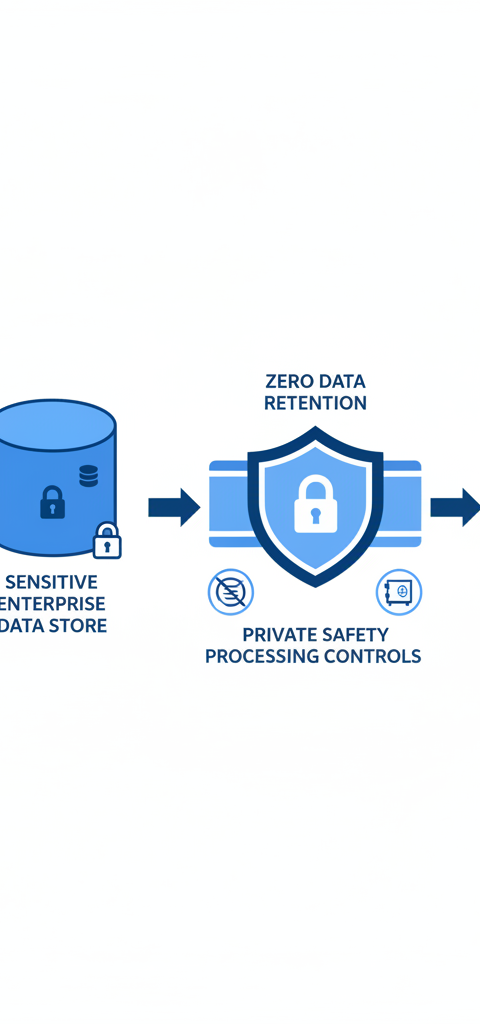
This is the first gate. If a vendor fails here, stop.
Ask:
- Is our data used to train or improve any model? Is that off by default, in writing?
- How long are prompts and outputs stored, and where? Can we set the period?
- Is there a zero data retention option, and which features does it exclude?
- Who can see our data, including staff and abuse reviewers?
- What happens to our data on termination, and how fast?
The answers differ by provider and by feature, so read the documents. Examples as of 26 October 2026:
- Anthropic's commercial terms say it may not train models on customer content from its services. Its data processing addendum gives 15 days to object to a new subprocessor, a 48 hour breach notice, and deletion within 30 days after the agreement ends, with some exceptions .
- OpenAI's API documentation says API data is not used to train its models unless you opt in. Abuse monitoring logs are kept up to 30 days by default. Zero data retention needs approval and some endpoints are not eligible .
- Google's Vertex AI documentation says it will not use your data to train models without permission. Gemini models cache data for up to 24 hours by default, and some features, such as grounding with Google Search, keep logs you cannot turn off .
The lesson is that "we do not train on your data" is not the same as "we do not keep your data". Ask about both.
2. Security certifications
Ask for the report, not the logo.
- SOC 2. A report by an independent CPA firm on controls against criteria that can cover security, availability, processing integrity, confidentiality and privacy . Ask for the latest report, its period, which services are in scope, and any exceptions noted. Ask whether it is a Type 1 or Type 2 report and what period it covers.
- ISO/IEC 27001:2022. Certification of an information security management system. The three-year transition from the 2013 edition ended on 31 October 2025, so certified firms should now hold the 2022 edition . Check the certificate's scope and expiry date.
- ISO/IEC 42001:2023. An AI management system standard published on 18 December 2023 . Ask whether the vendor holds it and which services it covers. It shows a management process, not that a given model is accurate.
- Penetration tests. Ask for a summary of the latest test and how findings were closed.
- LLM-specific risks. Ask how the product handles the OWASP Top 10 for LLM Applications (2025), including prompt injection, sensitive information disclosure and excessive agency .
3. Model providers and subprocessors
Ask for a written list of:
- The model or models used, and who provides them.
- Hosting regions and cloud providers.
- All subprocessors with access to your data.
- How and when you are told about changes.
Ask what happens when the vendor swaps the underlying model. Outputs can change overnight, so you need notice and a way to re-test.
If the vendor builds on a general-purpose model, ask what the model provider shares with it. Article 53 of the EU AI Act requires providers of general-purpose models to give downstream providers the information they need to understand the model and meet their own duties. This has applied since 2 August 2025 .
For open-weight models, read the licence. Meta's Llama 4 Community License requires a licence request from Meta above 700 million monthly active users, "Built with Llama" branding, and model names starting with "Llama" for derived models . That is not the same as an open-source licence, so check what applies to you.
4. Evaluation evidence
Marketing numbers are not evidence. Ask for:
- Results on a named test set, with the method and the date.
- Results on tasks like yours, not only public benchmarks.
- Error types, not just averages: wrong answers, made-up facts, refusals.
- How quality is tracked after launch and after model changes.
- Customer references in your sector that you can call.
Then run your own test in the pilot. The NIST AI Risk Management Framework describes this work as Measure: testing, assessing and monitoring AI risks over time .
5. SLAs and support
- Uptime commitment, how it is measured, and the credit if missed.
- Latency targets and rate limits, since these drive real user experience.
- Support hours, response times and an escalation path.
- Incident history and how past incidents were communicated.
- Notice period for model, price or terms changes.
6. Pricing and lock-in
- What is the unit: seats, tokens, calls, outcomes? Which one grows with your use?
- What are overage rules? Is there a hard cap you can set?
- Are prices fixed for the term? Anthropic's terms, for example, allow either side to end the agreement for convenience on notice, with 30 days from Anthropic . Check what notice your vendor must give you.
- What do you build on top that cannot move: prompts, fine-tuned models, vector stores, custom formats?
Keep prompts, documents and evaluation sets in your hands, in open formats.
7. Exit
Agree the exit before you sign.
- Export of all your data and configuration, in a usable format, within a set time.
- Deletion of all copies, including at subprocessors, with written confirmation. Anthropic's addendum is one example of a stated return and deletion window .
- Help with transition, and what it costs.
- What happens if the vendor is acquired or shuts down.
8. Compliance
- Does the vendor sign a data processing agreement, and does it cover subprocessors?
- Where is data stored and processed? Is cross-border transfer covered?
- Can the vendor give the documents you would need as a deployer under the EU AI Act, such as instructions for use?
- For India, will the vendor meet breach reporting and erasure duties when the DPDP Rules' main duties start on 13 May 2027?
- Does the product need transparency labels? Article 50 of the AI Act applies from 2 August 2026 .
Scorecard
Score each vendor from 0 (no answer) to 5 (strong written evidence). Weights are suggestions. Change them to fit your risk.
| Category | Weight | Vendor A | Vendor B |
|---|---|---|---|
| Data use and retention | 20% | ||
| Security certifications | 15% | ||
| Model providers and subprocessors | 10% | ||
| Evaluation evidence | 15% | ||
| SLAs and support | 10% | ||
| Pricing and lock-in | 10% | ||
| Exit terms | 10% | ||
| Compliance | 10% |
Set a rule: any score of 0 or 1 on data use or security removes the vendor, whatever the total.
Red flags
- No written statement on training with your data.
- A security page with logos but no report you can read.
- Will not name the model provider or subprocessors.
- Only demo results, with no test method.
- Terms that let the vendor change models or prices without notice.
- No export path, or fees to get your own data back.
- Claims of "100% accuracy" or "no hallucinations".
Running a 2 to 4 week pilot
A pilot is a test of fit, not a free trial. Keep it short and scored.
Before it starts (a few days)
- Pick one use case and one owner.
- Write the success measures: quality, speed, cost per task and user satisfaction.
- Build an evaluation set of real examples with correct answers, including hard and edge cases. Remove or mask personal data you do not need.
- Get security and privacy to approve the data used.
Weeks 1 and 2
- Connect the product with the least access it needs.
- Run the evaluation set and record results. Run it again after any vendor change.
- Let a small group use it for real work and log problems.
Weeks 3 and 4 (if needed)
- Test failure cases: bad inputs, prompt injection attempts and outages.
- Check actual cost against the quote.
- Ask the vendor to show the data export and deletion steps.
At the end
- Fill in the scorecard with evidence from the pilot.
- Decide: buy, extend, or stop. Write down why.
Use the same test set for every vendor so scores can be compared.
FAQ
How many vendors should we pilot?
Two or three. More than that costs too much review time, and fewer gives you no comparison.
Is SOC 2 enough?
No. It shows security controls, not that the AI output is accurate or that your data is not used for training. Ask for both the report and the written data terms.
Do we need ISO/IEC 42001 from a vendor?
It is a helpful signal of a managed AI process, not a requirement in law. Check which services the certificate covers.
Do the EU AI Act and DPDP require us to audit vendors?
Neither text sets out a due diligence checklist. They do make you answerable for how vendors are used, so you need contracts and evidence .
Should we choose an open-weight model to avoid lock-in?
It can reduce lock-in, but you take on hosting and maintenance, and you must read the licence .
Sources
- Anthropic, Commercial Terms of Service: https://www.anthropic.com/legal/commercial-terms
- Anthropic, Data Processing Addendum: https://www.anthropic.com/legal/data-processing-addendum
- OpenAI, Data controls in the API platform: https://developers.openai.com/api/docs/guides/your-data
- Google Cloud, Vertex AI generative AI data governance: https://docs.cloud.google.com/vertex-ai/generative-ai/docs/data-governance
- AI Act Article 26, deployer obligations: https://artificialintelligenceact.eu/article/26/
- AICPA and CIMA, SOC suite of services: https://www.aicpa-cima.com/resources/landing/system-and-organization-controls-soc-suite-of-services
- LRQA, ISO 27001:2022 transition by October 2025: https://www.lrqa.com/en/insights/articles/preparing-for-iso-270012022-transition-by-october-2025/
- Hogan Lovells, India DPDP Act brought into force: https://www.hlc.com/en/publications/indias-digital-personal-data-protection-act-2023-brought-into-force-
- IEC webstore, ISO/IEC 42001:2023: https://webstore.iec.ch/publication/90574
- OWASP, Top 10 for LLM Applications 2025: https://genai.owasp.org/llm-top-10/
- AI Act Article 53, obligations for general-purpose AI model providers: https://artificialintelligenceact.eu/article/53/
- Meta, Llama 4 Community License Agreement: https://dev.meta.ai/llama/llama4/license/
- NIST, AI RMF core functions: https://airc.nist.gov/airmf-resources/airmf/5-sec-core/
- AI Act Article 50, transparency obligations: https://artificialintelligenceact.eu/article/50/
Interested in Enterprise AI Updates?
Occasional AI architecture, governance and platform engineering updates for CTOs and founders. Prefer a feed reader? RSS feed.
Vinod Kumar · Chief Executive Officer, ZigmaNeural
Vinod Kumar leads ZigmaNeural, advising enterprise leaders on AI strategy, connected products and technology investment decisions.
Reviewed by Ram Sharma on 26 October 2026
AI Toolkit
Tools to put this article to work
- AI readiness assessment21 questions, about 5 minutes. A score across strategy, data, platform, people, governance and delivery, with the full report emailed to you.Open the tool
- Should we use AI for this?Nine questions about one task give a verdict : go, pilot first or not yet, and a suggested approach.Open the tool
- AI agent ROI calculatorHours saved, running cost, 3-year net benefit and payback month, from your own volumes and costs.Open the tool