OpenAI Expands Zero Data Retention for Frontier AI Models: What It Means for Enterprise AI
OpenAI has reaffirmed Zero Data Retention for eligible API customers and previewed Private Safety Processing. Here is what that changes for enterprise AI architecture, data privacy, governance and vendor due diligence.
What does OpenAI Zero Data Retention mean for enterprises?
For eligible API customers, prompts and model responses are not retained after processing and enterprise data is not used for training unless the customer opts in, which removes one of the main blockers in enterprise AI security review.
Short Answer
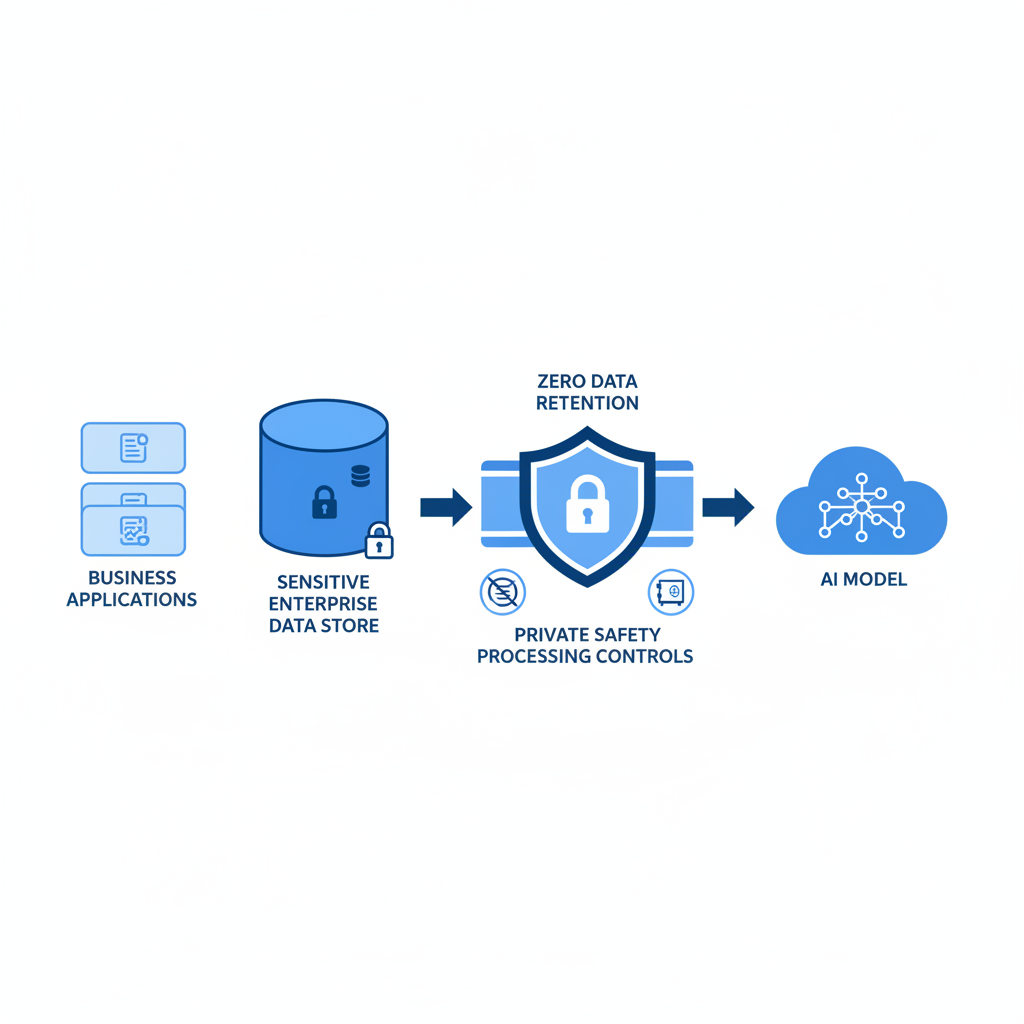
OpenAI has reaffirmed Zero Data Retention (ZDR) for eligible API customers and introduced a preview of Private Safety Processing for advanced AI safety workloads. For eligible ZDR customers, prompts and model responses are not retained after the request is processed, and enterprise customer data is not used to train models unless the customer explicitly opts in.
For most enterprises, the interesting part is not the announcement itself. It is what the announcement forces you to answer internally. The question has quietly shifted from *"which model is best?"* to *"can we use a powerful model without losing control of our data?"*
That is a very different conversation, and it usually involves security, legal, procurement and platform engineering rather than a single AI team.
Why This Landed on So Many Desks at Once
Over the last two years we have watched the same pattern repeat inside banks, hospital groups, manufacturers and software companies. A team builds a genuinely useful AI feature in a few weeks. Then it reaches security review and stops for six months.
The blocker is almost never model quality. It is a short list of unanswered questions about data:
- Where does the prompt actually travel?
- Is any copy of it retained, and for how long?
- Could it end up in training data?
- Who inside the vendor can read it?
- What evidence can we show an auditor or a regulator?
Retention commitments like ZDR matter because they turn one of those questions from an assumption into a contractual control. That is what unblocks review boards.
What Zero Data Retention Actually Means
Zero Data Retention means that, for eligible API customers, prompts and model responses are not stored after the request has been processed. There is no persistent copy of the content sitting at the provider waiting to be queried, subpoenaed or accidentally exposed.
This matters because production AI applications routinely send exactly the material your data classification policy says to protect:
- Customer records and account histories
- Source code and infrastructure configuration
- Contracts, MSAs and legal correspondence
- Internal financial reports and forecasts
- Product specifications and design documents
- Employee and HR information
The organisation still wants the model to reason over that material. It simply does not want a second copy of it to exist outside its own boundary.
One important caveat that teams miss: ZDR is an eligibility-based configuration, not a default that appears automatically because you pay for an API. Confirm in writing which endpoints, features and accounts it applies to before you assume coverage. Some capabilities that depend on stored state behave differently under a zero-retention configuration.
A Concrete Example
Picture a bank building an internal assistant that helps relationship managers understand policy. Someone types:
"Summarise this customer's loan history and explain why the application was declined."
The model needs that information to be useful. But the bank needs to be able to state, on the record, where the information went, how long it lived, who could see it, whether it trained anything, and how usage is audited.
Notice that only one of those five requirements is about the vendor. The other four are about your own architecture. This is the part organisations under-invest in.
AI Privacy Is an Architecture Problem, Not a Procurement Checkbox
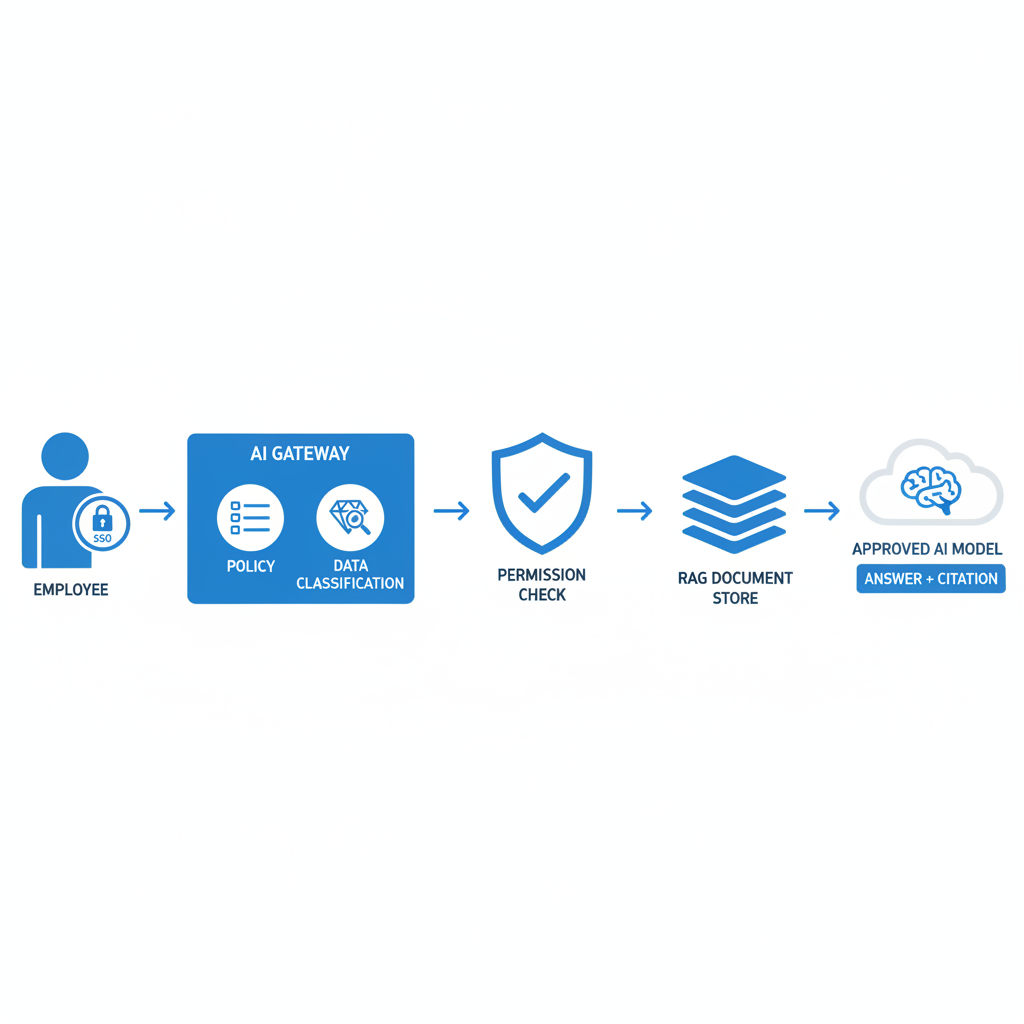
A production enterprise AI system rarely looks like an app talking straight to a model. It looks more like this:
`User → Enterprise Application → Security & Policy Layer → AI API → Model → Response → Audit Log`
That middle layer is where the real work sits, and it needs to handle:
- Authentication and authorisation — the model should only ever see data the requesting user is already entitled to see
- Data classification — knowing which fields are restricted before they leave your network
- Redaction and tokenisation — stripping or replacing identifiers that add no value to the answer
- Encryption in transit and at rest on your side
- Retention policy for your own logs, which are frequently the bigger exposure
- Prompt and response logging with configurable sensitivity
- Model access control — which teams may call which models, at what data classification
- Audit trails that a compliance reviewer can actually read
The uncomfortable truth we see in assessments: the provider often retains nothing, while the customer's own application logs quietly retain everything, in plain text, for ninety days, in a region nobody chose deliberately. Vendor retention is the headline. Your own logging is usually the real risk.
What Private Safety Processing Signals
OpenAI also describes Private Safety Processing, intended to allow advanced AI safety processing while preserving stronger privacy protections.
The specific mechanism matters less than the direction of travel. Historically, better safety and better privacy were traded off against each other: to catch misuse you inspected more content, centrally. The emerging design assumption is that safety checks can run inside more constrained, privacy-preserving environments.
That is the same architectural instinct enterprises are reaching for on their own: keep the sensitive material in the smallest possible blast radius, and move the controls to the data rather than the data to the controls.
Due Diligence: The Questions Worth Asking Before You Connect Anything
| Question | Why it matters |
|---|---|
| Is prompt and response data retained? | Determines your privacy exposure and breach surface |
| Is customer data used for model training? | Critical for confidential and regulated content |
| Can retention be contractually disabled? | Often required for DPIA and audit sign-off |
| In which regions is data processed? | Drives GDPR, DPDP, PDPL and residency compliance |
| What logs does the provider keep, and for how long? | Metadata retention is still retention |
| Who at the vendor can access data, and under what process? | Prevents undocumented insider access |
| Can sensitive fields be redacted before the call? | Cheapest control available; reduces exposure at source |
| Are sub-processors disclosed? | Your DPA obligations flow down the chain |
| How is usage monitored and attributed? | Needed to detect misuse and shadow AI |
| What happens on incident or breach? | Notification timelines belong in the contract, not a blog post |
If you cannot answer these for every model endpoint currently in use, you do not yet have an AI inventory — and an inventory is the precondition for governance under frameworks such as the [NIST AI Risk Management Framework](https://www.nist.gov/itl/ai-risk-management-framework) and ISO/IEC 42001.
Build, Buy, or Both
There is no universally correct answer here. There is a workload-by-workload answer.
Self-hosted and open source. Teams commonly assemble an internal AI gateway using components such as vLLM, Ollama, LiteLLM, Open WebUI and Kubernetes. You gain maximum control over where inference happens and what is logged. You also inherit responsibility for model hosting, GPU capacity, patching, scaling, evaluation, uptime and security. That is a platform team, not a side project.
Managed and commercial. Platforms such as the OpenAI API, AWS Bedrock, Microsoft Azure AI Foundry and Google Cloud Vertex AI remove most infrastructure work and typically offer stronger contractual and regional guarantees than a self-built stack achieves in its first year.
The pattern that usually wins. Route by data classification, not by preference. Public and internal-tier workloads go to managed frontier models under a ZDR configuration. Restricted-tier workloads — a narrow slice, usually under fifteen percent of volume — run on smaller self-hosted models inside your own network. One gateway, one policy engine, two backends.
How to Turn This Into Work You Can Actually Schedule
A practical sequence that fits inside a quarter:
- Inventory. List every application, endpoint and model currently in use, including the ones procurement does not know about.
- Classify. Tag each data flow against your existing classification scheme. Do not invent a new one for AI.
- Verify retention. Confirm in writing which flows are covered by ZDR-style commitments and which are not.
- Fix your own logs. Redact at source, shorten retention, pin the region. This is usually the fastest measurable win.
- Gate access. Put SSO, role checks and per-team model permissions in front of every call.
- Instrument. Log who asked what, against which model, at which classification — then review it monthly.
- Decide exceptions. Identify the small set of workloads that genuinely require private or self-hosted inference.
None of this requires new model capability. It requires an architecture decision and about six weeks of disciplined engineering.
What We Recommend
Treat retention commitments as a necessary input, not a finished answer. They remove one class of risk. They do not classify your data, scope your permissions, redact your prompts, shorten your own log retention, or give an auditor the evidence pack they will ask for.
Enterprise AI adoption is no longer decided on capability alone. The evaluation that actually predicts whether a system reaches production is:
Capability + Privacy + Security + Governance + Cost
Zero Data Retention is a meaningful improvement on the privacy axis. The remaining four are yours to engineer — and they are where our [AI governance framework](/governance) and [enterprise AI services](/services) work usually starts.
Frequently Asked Questions
What is Zero Data Retention in the OpenAI API?
It is a configuration for eligible API customers where prompts and model responses are not retained after processing. There is no persistent copy of the content at the provider once the request completes.
Does Zero Data Retention make an AI application compliant?
No. It removes one specific exposure. Compliance still depends on your lawful basis for processing, data minimisation, access control, your own log retention, regional processing, DPIA documentation and audit evidence.
Is enterprise data used to train OpenAI models?
OpenAI states that enterprise and API customer data is not used to train its models unless the customer explicitly opts in. Confirm the current terms for your specific agreement and endpoints.
Should sensitive workloads use self-hosted models instead?
Sometimes. A small subset of restricted workloads justifies private inference. For most enterprises the pragmatic pattern is a single AI gateway that routes by data classification, sending most traffic to managed models and a narrow slice to self-hosted ones.
What is the fastest way to reduce AI data exposure?
Redact identifiers before the call, shorten your own prompt and response log retention, and put SSO plus role checks in front of every model endpoint. These three changes usually cut exposure more than any vendor negotiation.
Who should own AI data retention decisions?
Jointly: security defines the controls, legal owns the contractual position, and platform engineering implements the gateway. Leaving it with the individual product team is how organisations end up with a dozen inconsistent configurations.
Questions this article answers
What is Zero Data Retention in the OpenAI API?
It is a configuration for eligible API customers where prompts and model responses are not retained after processing, so no persistent copy of the content remains at the provider once the request completes.
Does Zero Data Retention make an AI application compliant?
No. It removes one exposure. Compliance still depends on lawful basis, data minimisation, access control, your own log retention, regional processing, DPIA documentation and audit evidence.
Is enterprise data used to train OpenAI models?
OpenAI states that enterprise and API customer data is not used to train its models unless the customer explicitly opts in. Confirm the terms for your specific agreement and endpoints.
Should sensitive workloads use self-hosted models instead?
Only a small subset usually justifies private inference. The pragmatic pattern is one AI gateway that routes by data classification, sending most traffic to managed models and a narrow slice to self-hosted ones.
What is the fastest way to reduce AI data exposure?
Redact identifiers before the call, shorten your own prompt and response log retention, and enforce SSO plus role checks on every model endpoint.
Who should own AI data retention decisions?
Security defines controls, legal owns the contractual position and platform engineering implements the gateway. Leaving it to individual product teams produces inconsistent configurations.
Sources & references
Continue reading
Is your enterprise AI data actually secure?
We assess your AI architecture, data flows, retention controls and model usage before sensitive workloads reach production.
Stay ahead of enterprise AI
Get monthly briefings on AI architecture, governance, and platform engineering — written for CTOs and founders. No fluff.
Ram Sharma · Chief Technology Officer, ZigmaNeural
Ram Sharma leads AI platform, security and cloud engineering at ZigmaNeural, working with enterprise teams on governed AI architecture.