Samsung Is Bringing More AI Into Health: What Does Connected AI Care Mean?
Samsung is pushing AI deeper into Samsung Health and its connected device ecosystem. The wider lesson for enterprises is about turning continuous real-world sensor data into useful, private, trustworthy insight.
What does connected AI care actually mean?
It means wearables, sensors, software and AI operating as one system, where processing is distributed between device, edge and cloud so continuous health signals become personalised, private and actionable insight instead of raw readings.
Short Answer
Samsung is highlighting a more connected approach to health, combining Samsung Health with AI across its device ecosystem, in material published on 20 August 2026.
The notable trend is not "AI inside a health app." It is the combination of wearables, sensors, software, AI and personalised interpretation working as one system, with processing distributed between the device, the edge and the cloud.
That architectural pattern — continuous real-world data turned into contextual insight, close to where the data is produced — is the same pattern that will define industrial, logistics, retail and energy AI over the next few years. Health is simply where consumers will notice it first.
Why Raw Data Is Not the Product
A wearable can capture heart rate, heart rate variability, skin temperature, movement, sleep stages and blood oxygen continuously. That is an enormous volume of readings, and almost none of it is useful on its own.
Compare:
Heart rate: 71 bpm
with:
"Your resting heart rate has been four beats above your two-week baseline for three consecutive nights, alongside shorter deep sleep."
The second version is useful because it does four things the raw number does not: it establishes a personal baseline, detects deviation from it, correlates two signals, and expresses the result in language a person can act on.
That is the actual engineering problem in connected AI — not sensing, but interpretation. And interpretation quality depends far more on data continuity, personal baselining and context than on model size.
The Reference Architecture
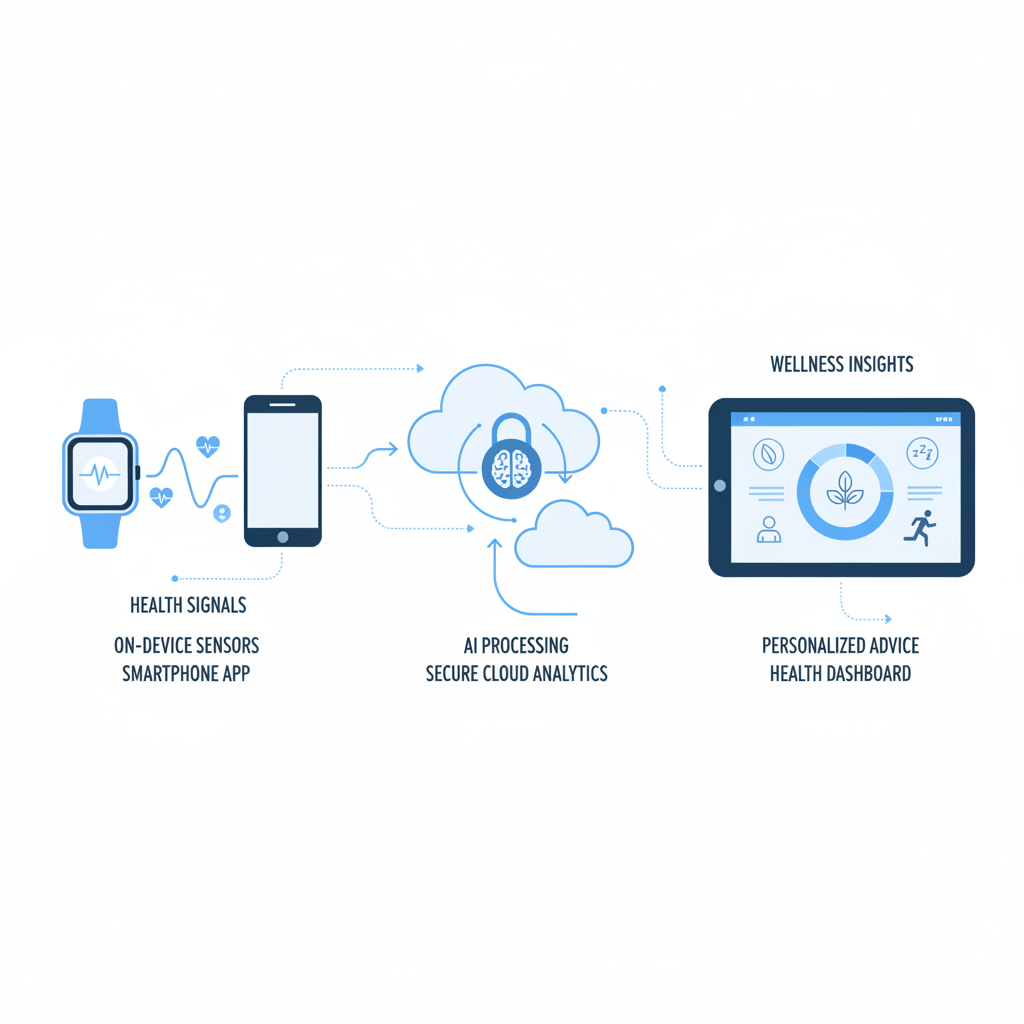
A connected AI health system typically looks like this:
`Sensors → Device (on-device processing) → Mobile app → Edge or cloud AI → Personalised insight → User action`
Where each stage runs is a deliberate design decision, not an implementation detail:
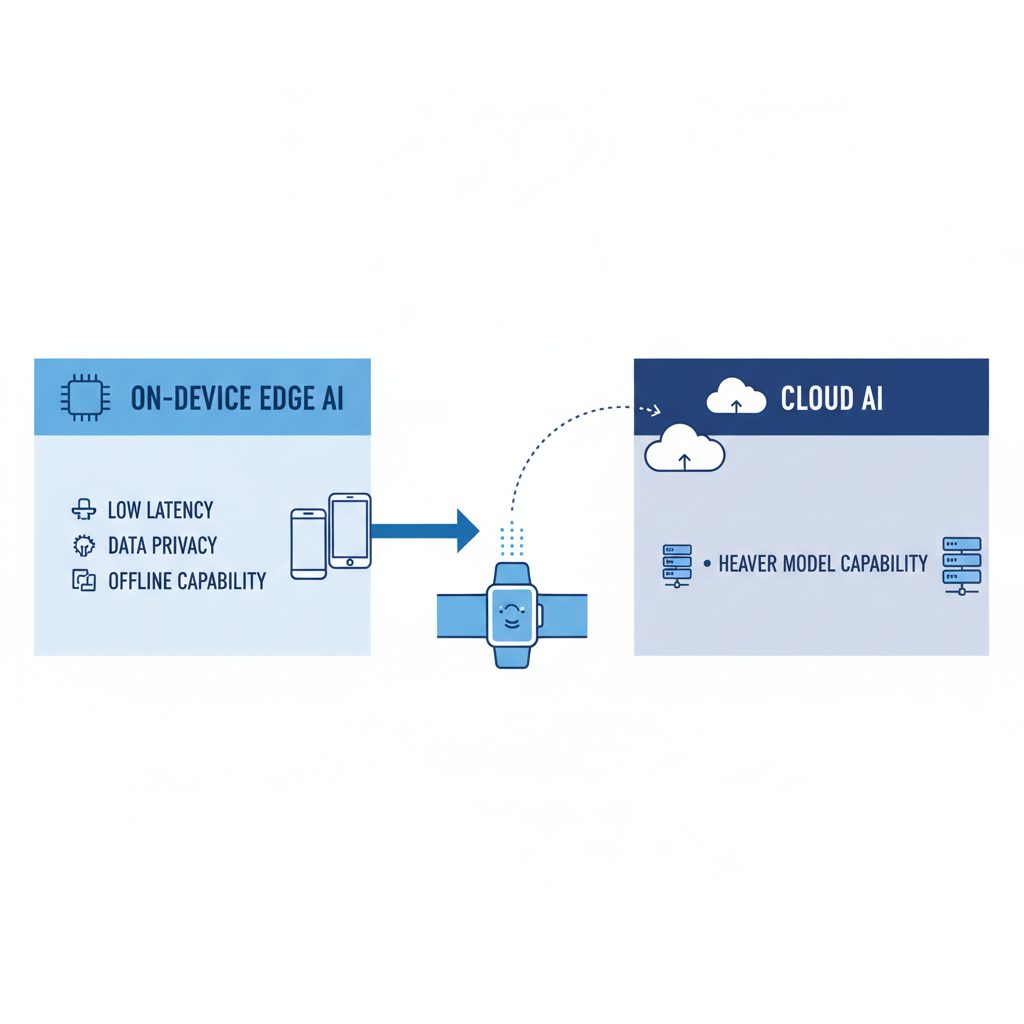
- On-device for high-frequency signal processing, anomaly detection and anything privacy-sensitive
- On the phone for aggregation across devices and short-term personal history
- In the cloud for heavier models, longitudinal trends and population-level baselines
- Hybrid, in practice, for almost every real product
Why Edge Processing Matters Here
Health signals are among the most sensitive categories of personal data in every major privacy regime. That reality pushes computation toward the device.
Processing at the edge offers:
- Lower latency — useful for real-time feedback during activity
- Reduced data transfer — continuous sensor streams are expensive to ship and store
- Stronger privacy — data that never leaves the device has a much smaller exposure surface
- Offline capability — the product still works without connectivity
- Lower operating cost — the cheapest inference is the one you do not pay a cloud provider for
The trade-offs are equally real: constrained memory and compute, battery consumption, harder model updates, and fragmentation across device generations. Longitudinal analysis and larger models still need the cloud.
The design rule we apply: push inference as close to the sensor as the accuracy requirement allows, and no closer. Then be explicit in your architecture documentation about which data crosses which boundary, because that document is what your privacy review will actually assess.
AI Assists — It Does Not Diagnose
This distinction is not legal boilerplate; it is a product design constraint that shapes the entire feature set.
Consumer AI health features can reasonably help people understand information, track patterns against their own baseline, set and monitor goals, organise records and receive timely reminders.
They must be carefully bounded around medical advice, diagnosis, treatment recommendations, data privacy, safety-critical alerting and regulatory classification. Wellness features and regulated medical device software sit in genuinely different categories, and the line is drawn by claims as much as by capability. Describing the same output as "your pattern changed" versus "you may have a condition" can move a product across that line.
Teams that decide their claim boundary during design ship. Teams that decide it during legal review rebuild.
The Pattern Generalises Beyond Health
Strip out the health specifics and the underlying pattern is universal:
`Continuous real-world data → AI interpretation → context → recommended action → measurable outcome`
The same architecture appears across sectors:
| Domain | Data source | Useful AI output |
|---|---|---|
| Manufacturing | Machine vibration, temperature, current draw | Predictive maintenance windows |
| Logistics | Vehicle telemetry, route, load, driver behaviour | Delay prediction and route correction |
| Retail | Footfall, basket, inventory movement | Local demand forecasting and replenishment |
| Energy | Smart meters, grid sensors | Load forecasting and anomaly detection |
| Agriculture | Soil moisture, weather, crop imagery | Irrigation and yield decisions |
| Facilities | Occupancy, HVAC, air quality | Comfort and energy optimisation |
In every row, the differentiator is not the model. It is data continuity, a trustworthy baseline, and an interface that turns the output into a decision someone will actually make.
What Usually Goes Wrong
The failure modes we see in connected AI projects are consistent and rarely about AI:
- No baseline. Population averages produce insights users recognise as generic and stop trusting.
- Broken data continuity. Gaps from connectivity, battery or app lifecycle silently destroy trend quality.
- Alert fatigue. Notifying on every deviation trains users to ignore all of them.
- Unclear consent. Users cannot tell what is collected, where it goes, or how to delete it.
- No feedback loop. Nobody measures whether the insight changed behaviour or outcomes.
- Cloud-by-default. Everything is streamed centrally, creating cost and privacy exposure that on-device processing would have avoided.
Fixing the first two typically improves perceived AI quality more than changing models.
Technology Options
Open source. TensorFlow Lite, ONNX Runtime and PyTorch (with mobile and edge runtimes) for on-device inference; Apache Kafka or MQTT for telemetry ingestion; TimescaleDB or PostgreSQL for time-series storage; Grafana and OpenTelemetry for observability.
Commercial. AWS, Microsoft Azure and Google Cloud each offer health-oriented and IoT data services with region and compliance controls, alongside commercial wearable and device APIs.
Selection should follow from four inputs, in this order: the sensitivity and residency requirements of the data, the regulatory classification of your claims, the capability of your target devices, and only then developer preference.
What We Recommend to Enterprises
If you own a connected product or a sensor estate, the sequence that works:
- Define the decision first. Which action should change as a result of this insight? If nobody can answer, the AI feature has no destination.
- Fix data continuity before modelling. Gap-filled, clock-aligned, deduplicated streams beat a better model on broken data.
- Baseline per entity — per user, per machine, per store. Deviation from self is almost always more actionable than deviation from average.
- Place inference deliberately. Document what runs on-device, at the edge and in cloud, and why.
- Set the claim boundary. Decide what you will and will not assert, and get it reviewed early.
- Make consent legible. Plain-language collection, retention, deletion and export.
- Measure the outcome, not the model. Behaviour change, downtime avoided, cost saved.
This is the work our [industry solutions](/industries) and [enterprise AI services](/services) engagements are usually built around, because it is where value and risk both concentrate.
Conclusion
Samsung's health direction reflects a broader shift: AI is being embedded into connected products rather than living in a standalone chat window. The advantage will not go to whoever uses the largest model. It will go to whoever combines good data, appropriate AI, useful interface design, credible privacy and reliable infrastructure.
For enterprises outside consumer devices, the takeaway is direct. You very likely already generate continuous real-world data. The question is whether it is continuous enough, contextual enough and trusted enough to act on.
Frequently Asked Questions
What is connected AI health?
It is an architecture where wearables and sensors collect continuous health signals, AI interprets them against a personal baseline, and the result is delivered as understandable insight across a connected device ecosystem rather than as raw numbers.
Why is on-device or edge AI used for health data?
Health signals are highly sensitive and high-frequency. Processing on-device reduces latency, data transfer and privacy exposure while enabling offline operation. Longitudinal analysis and larger models still typically run in the cloud.
Can AI diagnose medical conditions?
Consumer AI health features are designed to assist understanding, tracking and organisation — not to diagnose or treat. Diagnostic claims usually place software into a regulated medical device category with materially different obligations.
What makes an AI insight actually useful?
A personal baseline, deviation detection against that baseline, correlation across signals, and plain-language output tied to a specific action. Without a baseline, insights read as generic and users stop trusting them.
How does this apply outside healthcare?
The same pattern — continuous data, AI interpretation, context, action — drives predictive maintenance in manufacturing, delay prediction in logistics, demand forecasting in retail and load forecasting in energy.
What is the most common reason connected AI projects fail?
Data continuity and baselining, not model quality. Gaps in the stream and population-average comparisons undermine trust faster than any modelling limitation.
Questions this article answers
What is connected AI health?
An architecture where wearables and sensors collect continuous health signals, AI interprets them against a personal baseline, and the result is delivered as understandable insight across a connected device ecosystem rather than as raw numbers.
Why is on-device or edge AI used for health data?
Health signals are sensitive and high-frequency. On-device processing reduces latency, data transfer and privacy exposure and enables offline operation, while longitudinal analysis and larger models typically remain in the cloud.
Can AI diagnose medical conditions?
Consumer AI health features are designed to assist understanding, tracking and organisation, not to diagnose or treat. Diagnostic claims generally move software into a regulated medical device category.
What makes an AI insight actually useful?
A personal baseline, deviation detection against it, correlation across signals and plain-language output tied to a specific action. Without a baseline, insights read as generic and lose user trust.
How does this apply outside healthcare?
The same pattern drives predictive maintenance in manufacturing, delay prediction in logistics, demand forecasting in retail and load forecasting in energy: continuous data, AI interpretation, context, action.
What is the most common reason connected AI projects fail?
Data continuity and baselining rather than model quality. Stream gaps and population-average comparisons erode trust faster than any modelling limitation.
Sources & references
- Samsung Newsroom: Samsung Health and AI — Samsung (2026-08-20)
- Software as a Medical Device (SaMD) guidance — U.S. Food and Drug Administration
- General Data Protection Regulation - special categories of personal data — European Union
Continue reading
Turn your real-world data into insight people act on
We design connected AI architectures across device, edge and cloud with privacy, baselining and measurable outcomes built in.
Stay ahead of enterprise AI
Get monthly briefings on AI architecture, governance, and platform engineering — written for CTOs and founders. No fluff.
Vinod Kumar · Chief Executive Officer, ZigmaNeural
Vinod Kumar leads ZigmaNeural, advising enterprise leaders on AI strategy, connected products and technology investment decisions.