
How Can Enterprises Secure, Govern, and Monitor AI Agents?
A practical enterprise architecture for agentic AI: per-agent identity, action-level policy enforcement, containment, continuous evaluation, and a decision trail auditors accept.
How can enterprises secure, govern, and monitor AI agents?
Treat every agent as a scoped identity, enforce policy on each action outside the model, contain execution, and stream a complete decision trail into existing audit and observability tooling.
Short Answer
Enterprises secure, govern, and monitor AI agents by treating each agent as a first-class identity with scoped permissions, wrapping every tool call in policy enforcement, and streaming a complete decision trail into the same observability and audit platforms already used for production systems. In practice this means four control planes working together: identity and access, action-level policy, runtime evaluation, and continuous monitoring. Agents that cannot be attributed, constrained, replayed, and revoked should not reach production.
Why AI Agents Break the Assumptions Behind Existing Controls
Traditional enterprise software is deterministic. A service receives a request, executes a known code path, and produces an outcome that a reviewer can trace line by line. Access control assumes a human or a service account with a fixed scope. Change management assumes that behaviour changes only when code changes.
AI agents violate all three assumptions.
An agent decides at runtime which tools to call, in which order, and with which arguments. Its behaviour changes when the model version changes, when the prompt changes, when the retrieved context changes, and sometimes when nothing observable changes at all. It may act on behalf of a user in one step and on behalf of the organisation in the next. It can chain a benign read into a consequential write.
This is why organisations that have already invested heavily in cloud security, DevSecOps, and data governance still find themselves exposed when the first agent moves from prototype to production. The controls are not wrong; they are anchored to the wrong unit of work. The unit of work for an agent is not the deployment. It is the individual action.
The four failure patterns we see most often
- Unattributed action. An agent writes to a system of record using a shared service account, so the audit log shows a machine identity rather than the agent, the model version, the triggering user, and the reasoning path.
- Over-broad tool scope. An agent is granted a general-purpose API token because scoping it per task was harder, so a prompt-injected instruction inherits the full blast radius of that token.
- Unbounded autonomy. An agent is permitted to loop, retry, and spawn sub-tasks without a budget, so a single malformed goal becomes a runaway cost or a cascade of duplicate transactions.
- Invisible degradation. An agent silently becomes less accurate after a model or data change, and nobody notices because the only monitoring in place is uptime and latency.
Each of these is an architectural gap, not a model quality problem. No amount of prompt engineering closes them.
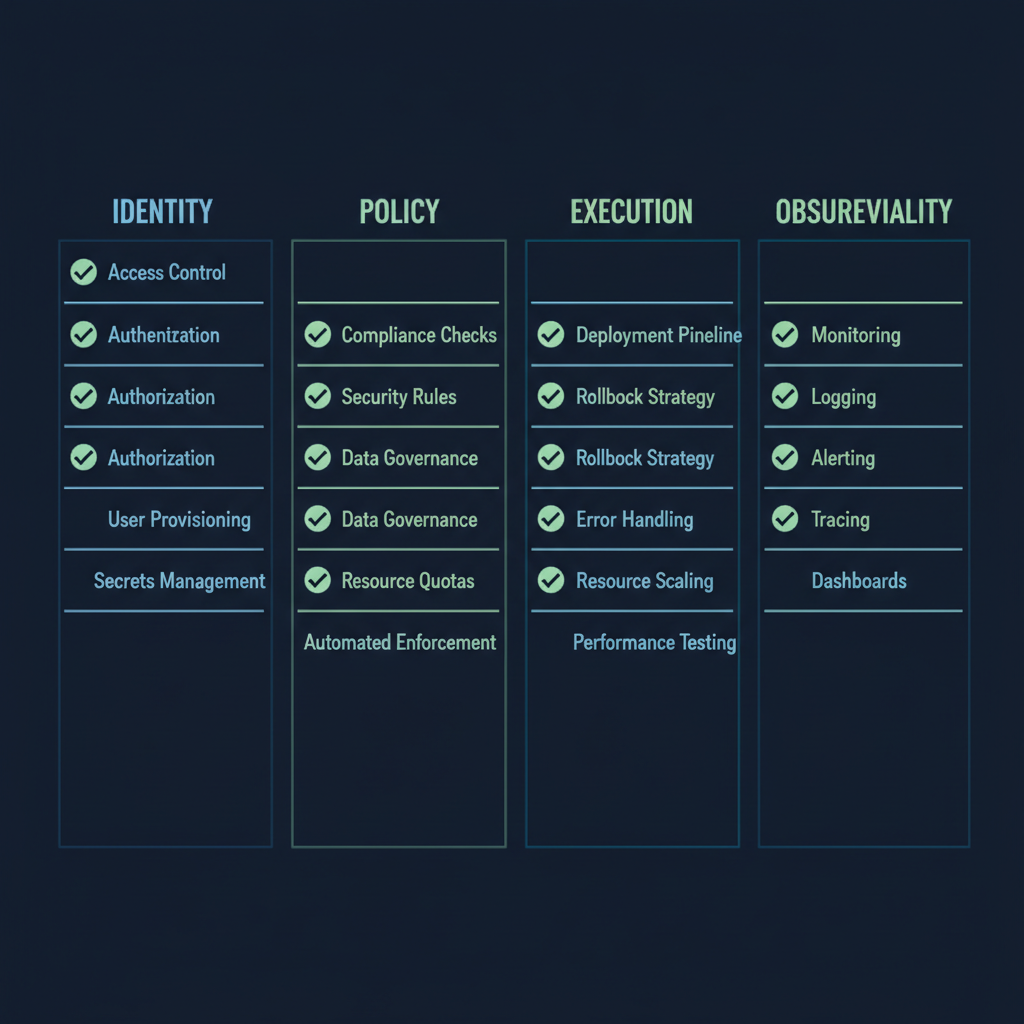
The Control Model: Four Planes
A defensible agent platform separates concerns into four planes. Teams that mix them end up with policy logic buried inside prompts, which is neither testable nor auditable.
1. Identity plane — who is acting
Every agent receives its own identity, distinct from the human who triggered it and from the application that hosts it. That identity carries:
- A stable agent ID and human-readable name.
- The owning team and an accountable owner.
- The model and model version currently bound to it.
- The set of tools it is permitted to call.
- The environments it may operate in.
- An expiry date, so dormant agents decay rather than linger.
Delegation must be explicit. When an agent acts for a user, the request should carry both identities so that downstream systems can enforce the intersection of the two permission sets. An agent must never be able to do more than the user it represents, and it must never be able to do everything its host application could do.
2. Policy plane — what may be done
Policy sits between the agent's intent and the tool that executes it. The agent proposes; the policy engine decides. This inversion is the single most important design choice in agent security, because it means safety no longer depends on the model behaving well.
Policies should be expressed as data, versioned in source control, and evaluated deterministically. Useful policy dimensions include:
- Tool allow-lists per agent and per environment.
- Argument constraints — value ranges, record ownership, tenant boundaries, allowed table or bucket names.
- Data classification rules — which sensitivity tiers an agent may read, and which it may transmit outside a boundary.
- Rate and budget limits — calls per minute, tokens per task, currency spend per day.
- Approval thresholds — actions above a value or risk score require human confirmation.
- Time and context windows — no production writes outside change windows.
3. Execution plane — how it is done safely
The execution plane is where the agent actually runs. Its job is containment.
- Tools are narrow, typed functions with validated inputs, never generic shells or arbitrary HTTP clients.
- Untrusted content — retrieved documents, emails, web pages, ticket bodies — is clearly delimited and never treated as instruction.
- Code execution, if permitted at all, happens in an ephemeral sandbox with no ambient credentials and no egress by default.
- Outbound network access uses an allow-list, because exfiltration is the terminal step in most agent attacks.
- Writes are idempotent, keyed by a task ID, so retries cannot duplicate side effects.
- Every consequential action is reversible or, where reversal is impossible, gated by approval.
4. Observability plane — what actually happened
Agents need a decision trail, not just a log line. For each task, capture:
- The triggering event and requesting identity.
- The resolved goal and the plan, if the agent produces one.
- Each tool call with arguments, policy decision, latency, and result status.
- Model identifiers, prompt version, and retrieval sources used.
- Token consumption and cost.
- The final outcome, including refusals and escalations.
- A correlation ID that ties the trail to existing application traces.
Store this in the same platform used for the rest of production telemetry. A separate, bespoke agent log is a governance liability because nobody looks at it during an incident.
Reference Architecture
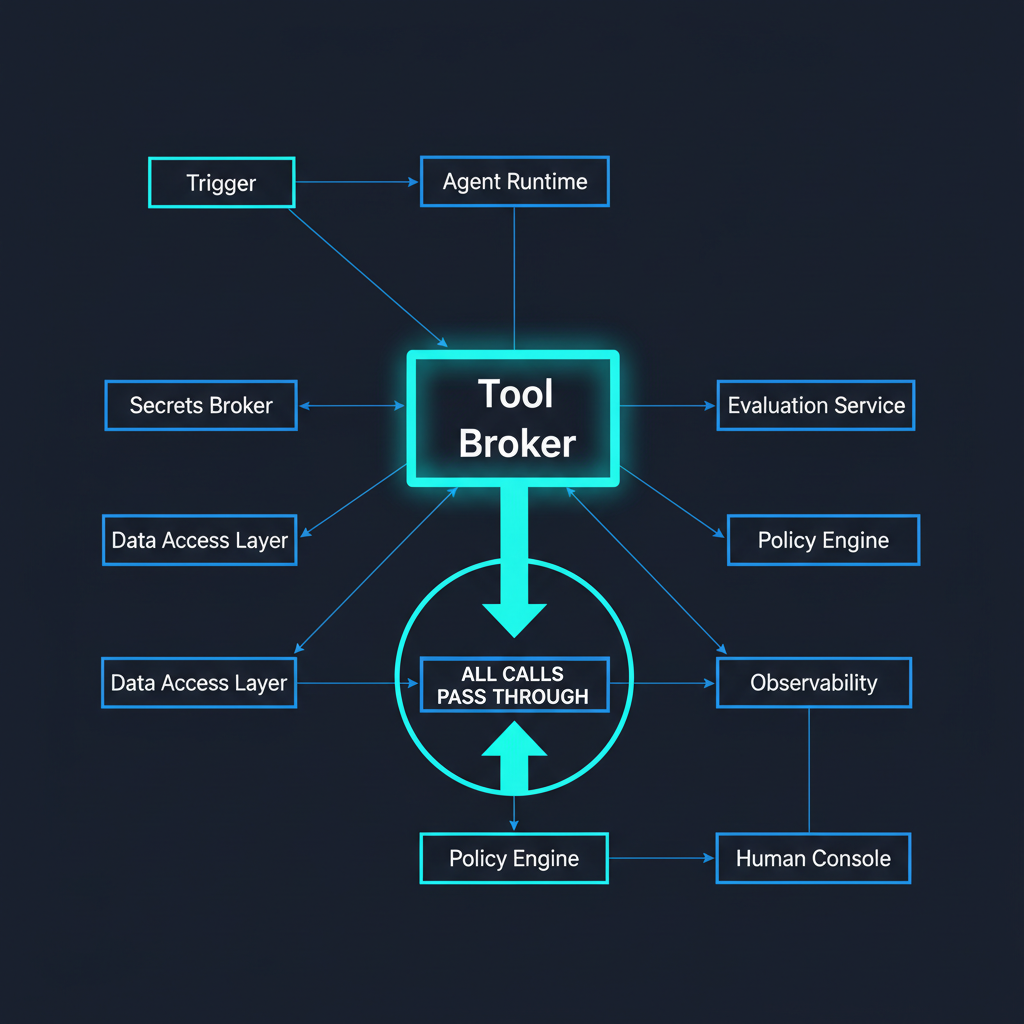
The pattern below is deliberately boring. It uses components most enterprises already operate, which is what makes it approvable.
| Layer | Responsibility | Typical implementation |
|---|---|---|
| Trigger | Receives user requests, events, or schedules | API gateway, message queue, workflow engine |
| Agent runtime | Plans, calls tools, manages memory | Container or serverless function per agent |
| Tool broker | Single choke point for every tool call | Internal service exposing typed, audited tools |
| Policy engine | Allow, deny, or escalate each action | Policy-as-code service with versioned rules |
| Secrets broker | Issues short-lived, scoped credentials | Existing secret manager with dynamic leases |
| Data access layer | Enforces tenancy and classification | Row-level security, views, masked columns |
| Evaluation service | Scores quality and safety pre- and post-release | Offline test suites plus online sampling |
| Observability | Traces, metrics, logs, cost, audit | Existing APM and SIEM |
| Human console | Review queue, approvals, kill switch | Internal admin application |
Two properties matter more than the specific products chosen.
First, the tool broker must be unavoidable. If an agent can reach a database or an external API directly, the policy engine is decorative. Network policy, credential scoping, and code review should all make direct access impossible rather than discouraged.
Second, the kill switch must be real. Operators need a single control that halts a specific agent, a specific tool, or all agent activity in an environment, and that takes effect within seconds for in-flight tasks. Test it on a schedule, the same way you test failover.
Threat Model for Agentic Systems
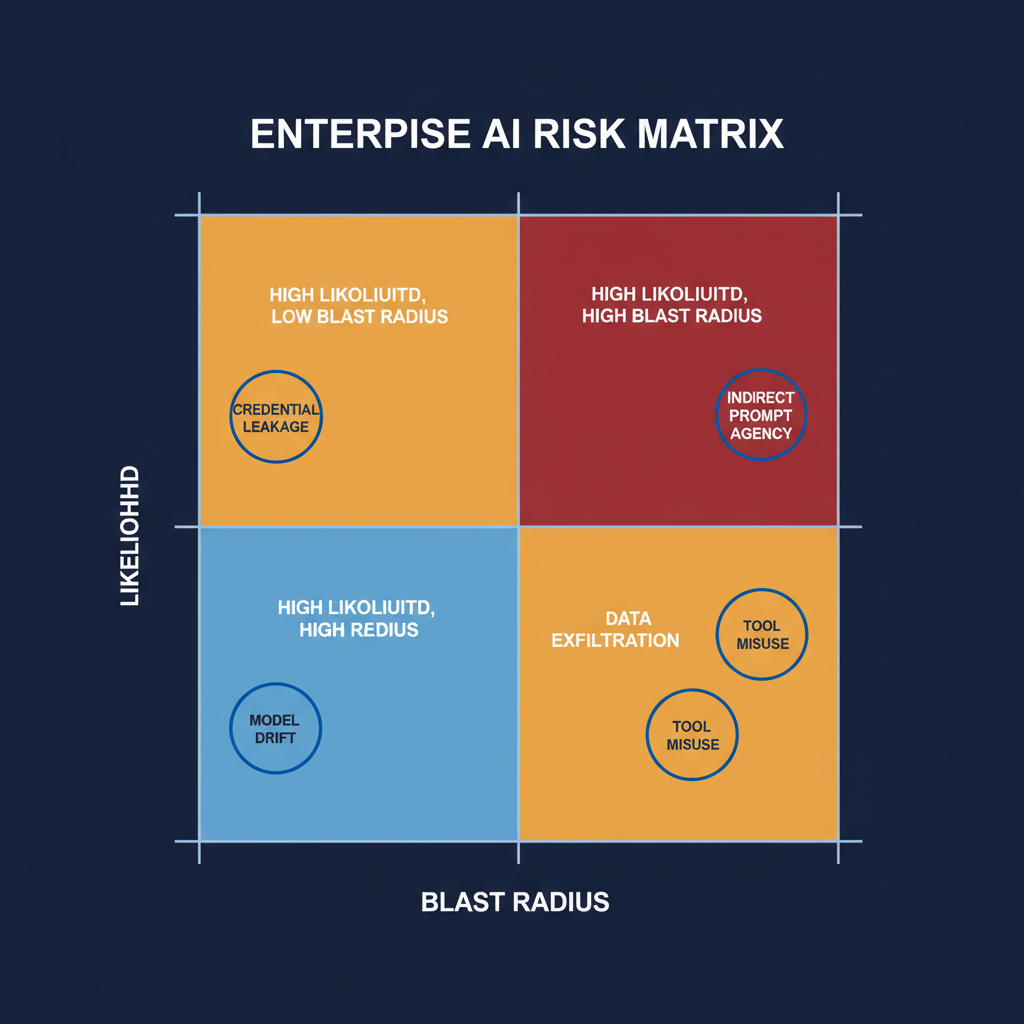
Security reviews stall when teams argue about scenarios without a shared model. The following categories cover the practical attack surface.
Prompt injection, direct and indirect
Direct injection is a user typing malicious instructions. Indirect injection is far more dangerous: instructions hidden in a document, a web page, a code comment, a calendar invite, or a support ticket that the agent later retrieves. The agent cannot reliably distinguish data from instruction, so the architecture must assume it will fail.
Mitigations that hold up:
- Structural separation of instructions and content, with content always labelled untrusted.
- Policy enforcement outside the model, so an injected instruction still cannot call a forbidden tool.
- Human approval for irreversible actions.
- Egress allow-lists, so exfiltration attempts fail even when the model is persuaded.
- Content provenance checks before high-risk retrieval sources are used at all.
Excessive agency
The agent is permitted to do more than the task requires. This is the agentic analogue of over-privileged IAM, and the fix is the same: derive permissions from the task, issue them just in time, and expire them quickly.
Tool poisoning and supply chain risk
Third-party tools, plug-ins, and Model Context Protocol servers execute inside your trust boundary. Treat them as dependencies: pin versions, review the code or the vendor, restrict their credentials, and monitor their outbound traffic. A tool description is itself an attack surface, because the model reads it.
Memory and context contamination
Persistent memory turns a one-off injection into a durable compromise. Scope memory per user and per tenant, expire it, exclude tool output from memory unless it has been validated, and provide an operator path to purge a poisoned memory store.
Model and data leakage
Agents assemble context from many sources, which makes them efficient aggregators of information a single user should never see together. Enforce classification at the data layer rather than in the prompt, redact before retrieval where possible, and log which sources contributed to each answer.
Cost and availability abuse
Loops, recursive delegation, and adversarial inputs can generate unbounded spend or exhaust downstream rate limits. Budgets per task, per agent, and per tenant belong in the policy plane, not in a dashboard someone checks weekly.
Identity confusion in multi-agent systems
When agents call agents, delegation chains lengthen and accountability blurs. Propagate the original caller through every hop, cap delegation depth, and refuse actions where the chain cannot be resolved.
Governance: Making Autonomy Approvable
Security controls answer "can this action happen safely?" Governance answers "should this agent exist, at this level of autonomy, for this purpose?" Enterprises that skip the second question end up with strong technical controls and no organisational confidence.
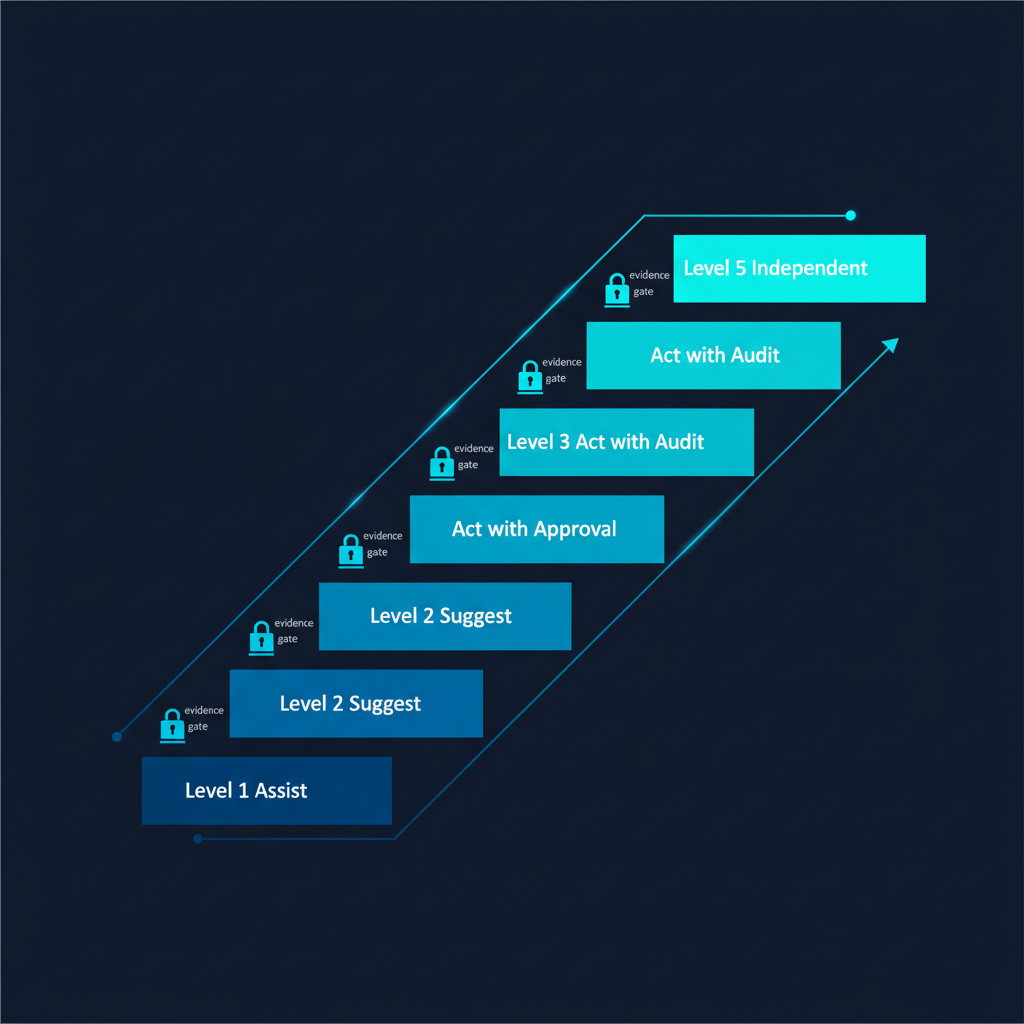
Define autonomy levels and require justification to move up
A simple ladder works better than a bespoke framework:
- Level 0 — Assist. The agent drafts; a human executes everything.
- Level 1 — Act with approval. The agent proposes actions; a human approves each one.
- Level 2 — Act within limits. The agent executes low-risk, reversible actions autonomously; anything above a defined threshold escalates.
- Level 3 — Act with oversight. The agent executes autonomously across a bounded domain; humans review samples and exceptions.
- Level 4 — Act independently. Reserved for narrow, well-instrumented, fully reversible domains with mature evaluation history.
Promotion between levels should require evidence: evaluation results, incident history, monitoring coverage, and a named accountable owner. Demotion should be automatic when evaluation scores or incident rates breach thresholds.
Maintain an agent register
Governance depends on knowing what exists. The register should record purpose, owner, autonomy level, tools, data classifications touched, model version, evaluation status, review date, and decommission criteria. It is the artefact auditors and regulators will ask for, and it is also what prevents the quiet accumulation of forgotten agents.
Map controls to frameworks you already report against
Most enterprises do not need a new compliance regime. They need to show how agent controls satisfy existing obligations. The NIST AI Risk Management Framework provides the govern, map, measure, manage structure. ISO/IEC 42001 provides the management-system shape that pairs naturally with an existing ISO/IEC 27001 programme. The EU AI Act adds obligations on transparency, risk classification, human oversight, and record-keeping for higher-risk uses. Sector rules — financial services, healthcare, public sector — still apply unchanged, and data protection regimes such as GDPR and India's DPDP Act govern the personal data an agent touches regardless of how autonomous it is.
The practical output is a control mapping table, maintained alongside the agent register, that links each technical control to the clauses it supports. This is what turns a good architecture into an approved one.
Assign clear accountability
Every agent needs a business owner accountable for outcomes, a technical owner accountable for the implementation, and a named reviewer for its evaluation results. Committees do not operate agents; people do.
Data Governance for Agent Context
Most agent risk is data risk wearing a different hat. An agent is, functionally, a very fast analyst with an unusually broad reach across systems that were never designed to be queried together.
Classify before you connect
Before an agent is given a retrieval source, the source needs a classification and a stated purpose. Three questions decide the design:
- What is the highest sensitivity tier in this source?
- Which populations of users are permitted to see each tier?
- Can the source be filtered before retrieval, or only after?
Filtering after retrieval means the sensitive content has already entered the context window, which means it has already entered logs, caches, and potentially a third-party model provider. Pre-retrieval filtering — through row-level security, tenant-scoped views, or separate indexes per classification — is the only durable answer.
Keep permissions in the data layer
It is tempting to instruct the model to withhold information the user should not see. That is not a control. Permissions must be enforced by the systems that own the data, using the delegated user identity, so the agent physically cannot retrieve what the user cannot read. Where a vector index is involved, that means per-document access metadata filtered at query time, not post-hoc reranking.
Track provenance
For every generated answer, record which sources contributed. Provenance serves three purposes at once: it supports groundedness metrics, it satisfies transparency obligations, and it makes incident investigation tractable when a bad answer reaches a customer.
Manage retention deliberately
Prompts, retrieved context, tool arguments, and outputs are all records. Decide retention periods per category, exclude or hash sensitive fields before logging, confirm whether your model provider retains inputs, and make sure deletion requests propagate to agent logs and memory stores. A data subject request that cannot reach your agent telemetry is a compliance gap.
Multi-Agent Systems: Extra Care Required
Multi-agent designs are attractive because they decompose complex work. They also multiply the surfaces described above, and they introduce failure modes that single-agent systems do not have.
- Delegation depth. Cap it. Unbounded delegation is how a small task becomes a large bill.
- Identity propagation. The original user must be visible at every hop, and each hop should narrow permissions rather than widen them.
- Message integrity. Treat inter-agent messages as untrusted input. One compromised agent should not be able to instruct its peers into privileged actions.
- Deadlock and thrash. Agents that hand work back and forth need timeouts, loop detection, and a supervisor that can terminate a stuck workflow.
- Shared memory. A common scratchpad is a contamination channel. Scope it per workflow instance and discard it on completion.
- Attribution. The decision trail must reconstruct the whole graph, not just the leaf call that touched a system of record.
A practical rule: introduce a second agent only when a single agent with better tools cannot do the job. Complexity should be earned.
Sector Considerations
The control model is the same everywhere, but the thresholds and evidence differ.
Financial services. Model risk management practices already exist; agents should be brought inside them rather than treated as a separate category. Expect strict approval thresholds for anything touching payments, positions, or customer records, and expect auditors to ask for the full decision trail on sampled transactions.
Healthcare and life sciences. Clinical safety and patient data protection dominate. Autonomy above Level 1 is rarely appropriate for anything that influences care decisions, and provenance is non-negotiable for clinical content.
Public sector. Transparency, contestability, and record-keeping obligations are heavier. Citizens affected by an automated action typically need an explanation and a route to human review, which means the human console is part of the service, not an internal tool.
Manufacturing and energy. Operational technology boundaries matter more than anything else. Agents should read from OT telemetry and write only to IT systems, with any control action passing through existing safety instrumented systems.
Retail and consumer. Cost and brand risk dominate. High-volume customer-facing agents need aggressive budget controls, tone evaluation, and rapid rollback, because a bad release is visible within minutes.
Roles and Responsibilities
Governance fails when it is nobody's day job. A workable split:
| Role | Owns |
|---|---|
| Business owner | Purpose, outcome measures, acceptance of residual risk |
| Platform engineering | Tool broker, policy engine, identity, observability |
| Agent developer | Tools, prompts, evaluation cases, runbooks |
| Security | Threat model, policy review, incident response, red teaming |
| Data governance | Classification, retention, provenance, subject rights |
| Risk and compliance | Control mapping, evidence, regulatory interpretation |
| On-call engineering | Alerts, kill switch, rollback, incident triage |
Red teaming deserves a specific mention. Schedule adversarial testing against agents the same way you schedule penetration testing against applications, and include indirect injection through every retrieval source the agent can reach. The findings belong in the evaluation suite, permanently.
Measuring Return Without Fooling Yourself
Agent programmes are frequently justified with time saved and then evaluated with adoption metrics, which is how organisations end up with enthusiasm and no evidence. Three measures keep the conversation honest:
- Cost per successful outcome, including model spend, human review time, and rework.
- Human override rate, trended over time. If it is not falling, the agent is not learning and neither is the team.
- Cycle time for the end-to-end business process, not the agent step in isolation. Automation that shifts work downstream is not automation.
Publish these alongside the reliability and safety metrics. A programme that reports value and risk in the same review earns far more latitude to expand autonomy than one that reports only wins.
A Worked Example: The Invoice Exception Agent
Abstract controls become concrete quickly when applied to a real workflow. Consider a finance agent that resolves invoice exceptions — mismatched purchase orders, missing tax fields, duplicate submissions.
Task. Given an exception, gather the invoice, the purchase order, the goods receipt, and prior correspondence; decide the likely cause; either correct low-risk metadata, request information from the supplier, or route to a human with a recommendation.
Identity. The agent has its own identity, owned by the finance systems team. Each run carries the requesting analyst's identity so that supplier and ledger access is intersected with the analyst's own entitlements.
Tools. Six typed tools, no more: `get_invoice`, `get_purchase_order`, `get_goods_receipt`, `search_correspondence`, `update_invoice_metadata`, `send_supplier_request`. There is no generic database tool and no generic email tool.
Policy. `update_invoice_metadata` is permitted only for a defined field allow-list, only where invoice value is below a threshold, and never where the supplier is flagged. `send_supplier_request` uses templated content, an approved supplier contact from the master record, and never a contact extracted from the invoice document itself — because that is precisely how payment redirection fraud arrives. Anything above the threshold escalates with a drafted recommendation.
Execution. Correspondence and invoice text are passed to the model as clearly delimited untrusted content. Updates are idempotent, keyed by exception ID. Egress is limited to the internal ERP and the approved mail relay.
Observability. Every run emits the exception ID, the documents retrieved, the diagnosis, each tool call with its policy decision, the outcome, and the cost. The finance operations dashboard shows resolution rate, escalation rate, override rate, and cost per resolved exception.
Evaluation. A regression set of two hundred historical exceptions with known correct outcomes runs on every change. Adversarial cases include invoices containing instructions to change bank details, duplicate submissions with altered references, and documents with contradictory totals.
Governance. The agent starts at Level 1, every action approved. After four weeks of stable evaluation and a clean override rate, metadata corrections below the threshold move to Level 2. Supplier communication stays gated for two quarters. The register records the owner, the autonomy level, the review date, and the condition that would trigger demotion.
Nothing in this design is exotic. That is the point: the same nine components handle a customer service agent, a cloud remediation agent, or an HR onboarding agent, with different tools and different thresholds.
Your First Thirty Days
If the platform work above feels large, the first month can be narrow and still valuable.
- Week 1. Complete the inventory. Suspend any agent that writes to a system of record using a shared credential.
- Week 2. Pick one agent that matters. Write its threat model and its decision-trail schema.
- Week 3. Route its tool calls through a broker, even a minimal one, and start emitting structured traces.
- Week 4. Add the first policies — tool allow-list, argument constraints, budget — plus a working kill switch, and rehearse using it.
At the end of the month you will have one agent you can defend in a security review and a template for the rest. That is a materially better position than a dozen prototypes nobody can account for.
Monitoring: What to Measure and Why
Uptime and latency tell you the agent is running. They tell you nothing about whether it is doing the right thing. Agent monitoring needs four categories of signal.
Reliability signals
- Task success rate, defined against an outcome the business recognises.
- Tool error rate, broken down by tool.
- Retry and loop counts per task.
- Escalation rate to humans, and the reason for each escalation.
- End-to-end task duration, including waiting on approvals.
Quality signals
- Accuracy or correctness against a maintained regression set.
- Groundedness — the proportion of claims traceable to retrieved sources.
- Refusal appropriateness, tracked in both directions: unnecessary refusals frustrate users, missing refusals create risk.
- Human override rate, which is the most honest quality metric you will get.
- Drift, measured as a change in these metrics after a model, prompt, or data update.
Safety and security signals
- Policy denials by rule, which reveal both attacks and badly scoped agents.
- Suspected injection attempts, flagged by content heuristics and classifier passes.
- Sensitive-data access events and classification violations.
- Egress attempts to non-allow-listed destinations.
- Anomalous tool sequences compared with a learned baseline.
- Credential issuance patterns from the secrets broker.
Cost signals
- Tokens and currency per task, per agent, per tenant.
- Cost per successful outcome, which is the only cost metric that supports investment decisions.
- Budget breach events and the action taken.
Route these into existing SIEM and APM tooling with alert thresholds owned by the same on-call rotation that owns the surrounding application. Agent incidents are production incidents.
Evaluation is a control, not a research activity
Treat evaluation as part of the release pipeline:
- Maintain a versioned test set of representative and adversarial tasks.
- Run it on every prompt, tool, model, or policy change, and block release on regression.
- Sample live traffic continuously and score it offline, because production distributions drift away from test sets.
- Feed every incident back into the test set so the same failure cannot recur silently.
- Review evaluation trends at the same cadence as other engineering quality metrics.
Implementation Roadmap
The sequence below is what we recommend to enterprises moving from pilots to a governed platform. Each phase produces an artefact that the next phase depends on, and none of it requires a big-bang programme.
- Inventory (weeks 1–2). Find every agent, copilot, and automation already in use, including the ones built inside SaaS tools. Record purpose, owner, tools, and data touched. Expect the list to be longer than anyone predicted.
- Classify and triage (weeks 2–3). Rank by blast radius: what could this agent change, spend, send, or expose? Set a provisional autonomy level for each and suspend anything that cannot be attributed.
- Stand up the tool broker (weeks 3–6). Route one high-value agent's tool calls through a single audited service. Typed tools, validated arguments, structured logs.
- Add the policy engine (weeks 5–8). Move allow-lists, argument constraints, budgets, and approval thresholds out of prompts and into versioned policy.
- Give agents identities (weeks 6–9). Per-agent identity, short-lived scoped credentials, propagated user delegation, expiry by default.
- Instrument end to end (weeks 8–11). Decision trails into the existing observability stack, dashboards per agent, alerts wired to on-call, cost attribution live.
- Build the evaluation harness (weeks 10–13). Regression suite in the pipeline, adversarial cases included, release gates enforced.
- Establish governance artefacts (weeks 12–15). Agent register, autonomy ladder, control mapping, review cadence, decommission criteria.
- Rehearse incidents (weeks 14–16). Practise the kill switch, credential revocation, memory purge, and rollback. Write the runbook from the rehearsal, not before it.
- Scale by pattern (ongoing). Onboard further agents onto the platform rather than rebuilding controls per team.
Most organisations can complete phases one through six in a quarter with a small platform team, provided the tool broker is treated as a shared service from the start.
Build, Buy, or Extend
There is no single correct answer, but the decision is more tractable when separated by layer.
| Layer | Default recommendation | Reasoning |
|---|---|---|
| Agent runtime | Buy or use open frameworks | Commodity, changes fast, low differentiation |
| Tool broker | Build | Encodes your systems, your semantics, your audit needs |
| Policy engine | Buy or adopt open policy-as-code | Mature category, avoid inventing a rules language |
| Secrets and identity | Extend existing | You already have the platform and the operational muscle |
| Observability | Extend existing | Consolidation beats a separate agent-only stack |
| Evaluation | Build the test sets, buy the harness | Your test cases are the asset, not the runner |
| Human console | Build thin | Must fit your approval culture and existing workflows |
The failure mode to avoid is buying an end-to-end agent platform that hides the policy and audit layers. If you cannot export the decision trail or express policy as code you control, you have outsourced your governance.
Common Mistakes
- Putting safety rules only in the system prompt. Prompts are guidance, not enforcement. Anything that must not happen belongs in the policy plane.
- Sharing one service account across agents. Attribution collapses and least privilege becomes impossible.
- Logging text instead of structure. Free-text logs cannot be queried during an incident or aggregated into quality metrics.
- Treating retrieved content as trusted. Indirect injection is the most common real-world agent attack path.
- Skipping cost controls until the first invoice. Budgets are a safety control, because runaway loops are also availability incidents.
- No decommission path. Agents that nobody owns keep running with credentials nobody reviews.
- Evaluating once, at launch. Without continuous evaluation, quality regressions are discovered by customers.
- Granting production write access before the kill switch is tested. Containment must be proven before autonomy is granted.
Production Readiness Checklist
Use this as a release gate. Anything unchecked is a documented, accepted risk with an owner and a date.
- Agent has a unique identity, named owner, and recorded purpose.
- Tool list is explicit, minimal, and typed.
- Every tool call passes through the broker and the policy engine.
- Credentials are short-lived, scoped, and issued just in time.
- User delegation is propagated and permissions are intersected.
- Irreversible or high-value actions require human approval.
- Untrusted content is delimited and never executed as instruction.
- Egress is restricted to an allow-list.
- Writes are idempotent and keyed by task ID.
- Token, call, and currency budgets are enforced per task and per day.
- Full decision trail is emitted to the central observability platform.
- Dashboards and alerts exist and are owned by an on-call rotation.
- Regression and adversarial evaluation suites gate every release.
- Live traffic is sampled and scored continuously.
- Memory is scoped, expiring, and purgeable.
- Kill switch is implemented and tested within the last quarter.
- Rollback and credential revocation runbooks exist and have been rehearsed.
- Agent appears in the register with an autonomy level and review date.
- Control mapping to NIST AI RMF, ISO/IEC 42001, and applicable sector rules is current.
- Decommission criteria and expiry date are recorded.
What Good Looks Like After Two Quarters
Enterprises that get this right share a recognisable end state. Agents are onboarded onto a platform rather than built from scratch. Security review takes days because the questions are already answered by the architecture. Operators can answer "what did this agent do, on whose behalf, using which data, at what cost?" in under a minute. Autonomy expands gradually and reversibly, backed by evidence. And crucially, the business trusts the system enough to give it work that matters.
That trust is the actual deliverable. The controls exist to earn it.
Conclusion
Agentic AI does not require a new security philosophy. It requires applying established principles — least privilege, defence in depth, separation of duties, auditability, testability — at a finer granularity than most enterprises are used to, because the unit of risk has shifted from the deployment to the individual action.
Start with the tool broker and the decision trail. They cost the least, unlock the most, and make every subsequent control easier to add. Then layer identity, policy, evaluation, and governance until autonomy becomes a decision you can defend rather than a risk you tolerate.
If you are moving agents from pilot to production and need an architecture that will survive security review and audit, our team can help you design the control planes and the governance artefacts around them.
Questions this article answers
How do enterprises secure AI agents?
By giving each agent its own identity, restricting it to narrow typed tools, enforcing policy outside the model at the point of every tool call, containing execution with short-lived scoped credentials and egress allow-lists, and streaming a full decision trail into existing observability and audit platforms.
What is AI agent governance?
Governance decides whether an agent should exist, at what level of autonomy, for what purpose, and under whose accountability. In practice it means an agent register, a defined autonomy ladder with promotion evidence, named business and technical owners, control mappings to frameworks already reported against, and decommission criteria.
How should AI agents be monitored in production?
Monitor four signal categories: reliability such as task success and escalation rate, quality such as groundedness and human override rate, safety such as policy denials and suspected injection attempts, and cost per successful outcome. Route all of it into the existing APM and SIEM with alerts owned by the same on-call rotation.
What is the difference between direct and indirect prompt injection?
Direct injection is a user typing malicious instructions into the agent. Indirect injection hides instructions in content the agent later retrieves, such as a document, ticket, calendar invite or web page. Indirect injection is the more common enterprise attack path because the malicious content arrives through trusted workflows.
What autonomy levels should enterprises use for AI agents?
A five-step ladder works well: assist only, act with per-action approval, act autonomously within reversible limits, act with sampled human oversight, and act independently in narrow well-instrumented domains. Promotion requires evaluation evidence and clean incident history; demotion should be automatic when thresholds are breached.
Should enterprises build or buy an agent platform?
Buy or adopt open source for the agent runtime and policy engine, extend existing identity, secrets and observability platforms, and build the tool broker, evaluation test sets and human console. Avoid any platform that hides the policy layer or prevents exporting the decision trail, because that outsources governance.
Which frameworks apply to enterprise AI agents?
The NIST AI Risk Management Framework provides the govern, map, measure, manage structure. ISO/IEC 42001 supplies the management-system shape alongside ISO/IEC 27001. The EU AI Act adds transparency, oversight and record-keeping duties for higher-risk uses, while GDPR, India’s DPDP Act and sector rules continue to apply unchanged.
Sources & references
Continue reading
- AI governance frameworkGovernance artefacts and control mapping
- enterprise AI servicesDelivery capability for agent platforms
- AI readiness assessmentPrimary conversion path
- trust and security practicesSecurity posture evidence
- decision frameworksBuild vs buy decisioning
- enterprise AI use casesApplied agent workflows
- industry solutionsSector considerations section
- talk to our teamClosing CTA
Moving AI agents from pilot to production?
We design the identity, policy, observability and governance layers that let enterprise agents pass security review and audit.
Stay ahead of enterprise AI
Get monthly briefings on AI architecture, governance, and platform engineering — written for CTOs and founders. No fluff.
Ram Sharma · Chief Technology Officer, ZigmaNeural
Ram Sharma leads platform, cloud and AI engineering at ZigmaNeural, advising enterprises on agentic AI architecture, governance and production readiness.